

Exploring your body is like learning a new language. Most people know the basics, but few understand the full depth of their own anatomy. Your body is a map of potential sensations waiting to be discovered. By understanding where these sensitive areas are, you can transform your personal experience and connection to yourself. This journey starts with simple curiosity and leads to a profound sense of embodiment. Through the practice of yoni massage, you can navigate this map with confidence and grace.
What Are Erogenous Spots?
Many people think of erogenous spots as tiny points on the skin. In reality, they are often large zones filled with many nerve endings.
The word “erogenous” itself tells a story about how these zones work. It comes from two Greek words: “eros,” which means love or desire, and “genous,” which means producing or giving birth to. So, an erogenous zone is literally a place that produces desire.
These areas involve a mix of blood vessels, muscles, and connective tissues. When you touch these zones, the nervous system sends signals directly to the brain. This creates a wide range of feelings, from calm relaxation to intense joy. Understanding that these are zones rather than dots helps you explore them with more variety and patience.
The Labia: The Outer Somatic Gates
Before exploring the deeper internal areas, every somatic journey begins at the entrance. The outer and inner lips act as the physical protectors of the female center. While they might not be the primary erogenous zones for a massive peak, they play a huge role in building trust.
In yoni massage, we always start by warming up the labia minora and majora to help the nervous system relax completely. By gently massaging these outer gates first, the body learns that the touch is safe and demands nothing. This slow preparation naturally opens the pathway for deeper exploration without shocking the delicate physical senses.
The V-Spot and the Gateway of the Vestibule
Before moving into the internal canal, the practitioner must honor the vaginal vestibule, often called the V-spot. This area acts as the “front porch” of the body, located between the small labia. It contains the openings of the urethra and the vagina. Because the skin here is very thin and full of nerves, it reacts quickly to the lightest touch.
In yoni massage, we treat this zone as a sacred gate. Developing a deep understanding of the vaginal vestibule is vital because it prepares the entire nervous system for deep sensitivity. When this gateway is relaxed, the body feels safe to open up completely for a deeper somatic journey.
The Clitourethrovaginal (CUV) Complex
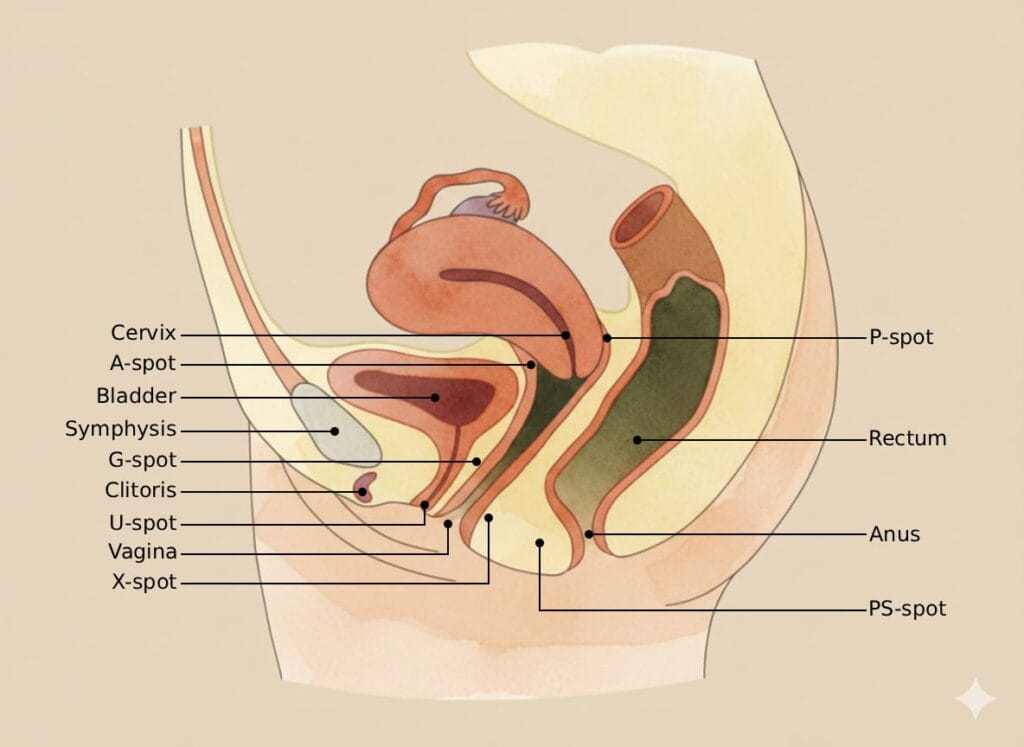
Modern science now views female pleasure through the lens of the integrated clitoral urethral vaginal complex rather than separate parts. The G-spot is a perfect example of this connection. It is not a separate organ but a projection of the internal clitoral bulbs against the vaginal wall. This area also includes the nerves of the urethral sponge and the female prostate, which surround the urethra. When you stimulate this zone during yoni massage, you are engaging a deep network of erectile tissue and glands. This complex is the engine of female arousal and plays a vital role in somatic health.
The U-Spot and Urethral Sensitivity
Just below the clitoral glans lies another highly sensitive area known as the U-spot. This stands for the urethral spot. For a long time, this small zone was ignored, but it is a vital part of the pleasure map. It connects to the urethral sponge, a network of tissue that swells with blood during arousal. Because it shares a dense network of nerves with the clitoral bulbs, touching this area can bring intense, radiating sensations. However, exploring the U-spot requires a very soft, mindful touch and strict hygiene. By using small circular motions and watching the body’s signals, you can safely awaken this dormant area and discover a completely unique pathway to physical joy.
Deep Exploration: The Cervix and Fornix Zones
As you move deeper into the body, you encounter the cervix. This is the lower part of the uterus that extends into the vagina, and it can be gently massaged during a yoni massage session.
The place where the vaginal walls meet and connect to the cervix is called the fornix. This area is like a circular pocket surrounding the cervix, and it is where much of the internal sensitivity is concentrated.
The A-spot is found on the front part of this connection, on the anterior wall. It is famous for its role in natural lubrication and helping the body prepare for deeper intimacy.
On the opposite side, tucked behind the cervix in the posterior fornix, you find the P-spot. This area is linked to deep somatic release and often stores emotional stress held in the pelvic tissues.
Neural Pathways of the Deep Pelvis
The reason these deep zones feel so different from the entrance is because of their complex nerve network. The cervix and the surrounding fornix areas are connected to the vagus nerve, which brings a sense of deep calm and bonding directly to the brain. However, this area also relies on the hypogastric nerves to send signals of internal pressure and feeling. Additionally, the pudendal nerve helps the vaginal portion of the cervix stay sensitive to touch. These nerves travel along the sacral ligaments, meaning that deep touch here connects the physical body to the most subconscious levels of human response.
The Perineum and the PS-Spot
The PS-spot is located on the perineum, which is the space between the vagina and the anus. This area acts as a physical anchor for the pelvic floor muscles. It is an erectile zone that becomes firm and sensitive during arousal. Touching the PS-spot helps to ground the energy of the entire pelvic region. It connects the external sensations to the internal ones, creating a unified feeling of presence in the body.
Neural Bridge: The Nipple-Genital Loop
Sensations do not only happen in the pelvis. The chest and the lower body share a powerful neural connection. Brain scans show that stimulating the nipples activates the exact same brain region as the genitals. The brain processes touch from both areas in the exact same place. Touching the chest also causes a direct release of oxytocin. This hormone calms the nervous system and creates subtle, warm contractions in the womb. In yoni massage, working with this active upper pole first builds deep trust. It prepares the pelvic region for touch by creating a profound sense of somatic safety.
The Architecture of Fantasy and Imagination
The mind is the most powerful tool in the alphabet of pleasure. The brain primes the entire nervous system long before any physical touch even occurs. A healthy fantasy life sends natural signals directly to the pelvic region, increasing blood flow and deep sensitivity. Imagination creates a secure mental space where the body can fully relax and drop its emotional armor. Nurturing this internal architecture helps the body stay vibrant. It keeps the nervous system open, curious, and completely ready for somatic exploration.
The Ambiguous Alphabet: Non-Standardized Zones
While some anatomical terms are clear, many letters in the pleasure alphabet do not have a single fixed location or a universally accepted definition. These terms often change meaning depending on the school of massage, the specific book you read, or the personal experience of the practitioner. Because there is no official scientific map for these specific labels, they remain subjective and flexible:
C-spot: This label is highly debated. Some use it to refer to the clitoris, others use it for the sensitive areas beside the clitoral hood, and some even use it for the cervix.
H-spot: There is no standard agreement on this point; it usually stands for the urethral area, making it essentially the same as the U-spot.
K-spot: Known as the Kundalini spot, its location varies greatly in different teachings, being placed either in the external perineum or deep just above the anus.
O-spot: This is a descriptive term for the “deep spot.” It does not have its own anatomical structure and usually corresponds to the P-spot in the posterior fornix.
Conclusion: Mastering the Map through Education
Every woman has a unique map of sensitivity that changes over time. Because there is no single “right” way to feel, a practitioner must learn to listen to the body’s subtle signals rather than follow a rigid script. Mastering these techniques requires a deep understanding of both anatomy and somatic safety. To learn how to professionaly massage these key areas and guide others toward deeper awareness, you can join our yoni massage practitioner training. This training will help you turn anatomical theory into a skilled practice that respects the individual journey of every woman.