

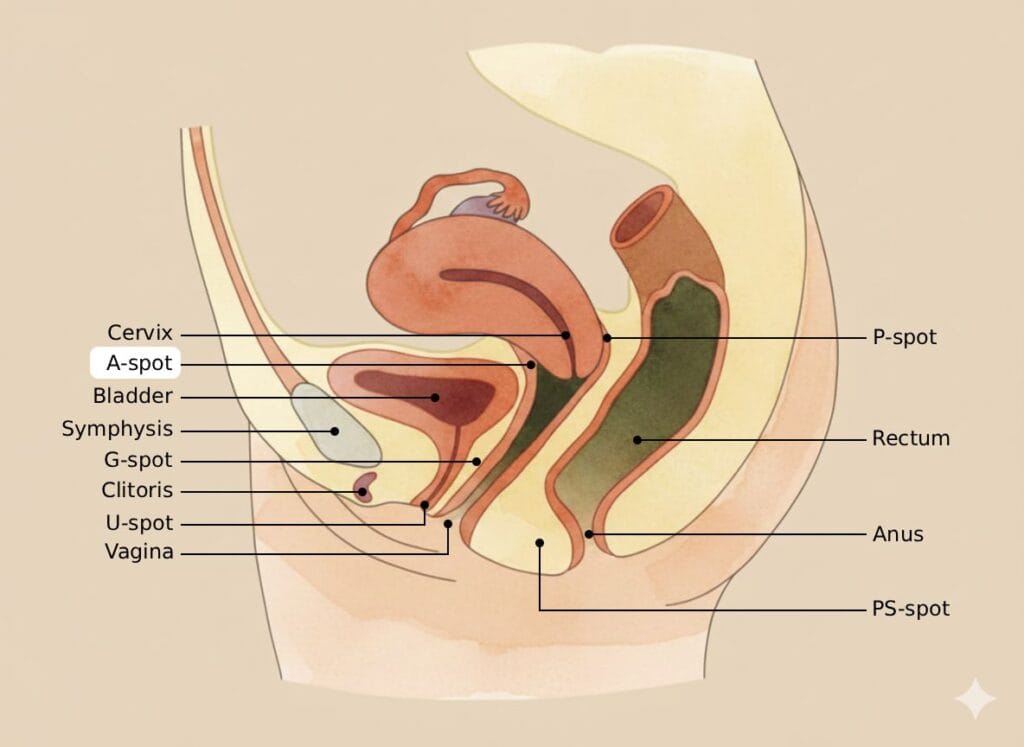
The A-spot — also called the AFE zone — sits deep inside the vaginal canal, just in front of the cervix. It is one of the most powerful erogenous zones in the female body, and one of the least talked about.
Touch it and the body responds fast. Natural lubrication rises within seconds. Sensitivity increases. The pelvic floor softens and opens.
This is not arousal through fantasy or mental effort. It is a direct physical reflex. For practitioners of yoni massage, knowing this zone changes a lot.
What Is the A-Spot and Where Is It Located
The A-spot is a small area of sensitive tissue on the front wall of the vaginal canal. It sits right where soft vaginal tissue meets the firm base of the cervix.
This area is the anterior fornix — the front pocket where the vaginal walls meet the neck of the uterus. The full name is the Anterior Fornix Erogenous zone, or AFE zone.
To find it, move your finger deep toward the cervix. The upper wall feels very soft — like the inside of your cheek. Go deeper and you reach the cervix, which feels like the tip of your nose. Right at the border between these two textures — smooth for some women, a thin ridge for others — is where the zone begins.
Dr. Chua Chee Ann and His Discovery
A physician from Malaysia named Chua Chee Ann identified the AFE zone in the 1990s. He worked with women who had chronic vaginal dryness and pain during intimacy. His aim was to trigger the body’s own lubrication — without gels or pills.
Direct pressure on the anterior fornix sent an instant signal to the pelvic blood vessels. Tissues swelled. Fluid followed. Two-thirds of Dr. Chua’s patients felt a real change after just one session.
He named the discovery the Anterior Fornix Erogenous Zone and published his findings in 1997. His technique is now part of somatic bodywork and yoni massage practice worldwide.
How the A-Spot Reflex Works
Most arousal starts in the mind. A thought, an image, an emotion — and the body follows. The A-spot works by a different path.
Dr. Chua called it a bypass reflex. Touch the anterior fornix and a direct signal travels to the pelvic blood flow. Blood fills the sponge tissue near the vaginal walls. Fluid appears — without any mental warm-up needed.
This reflex fires under stress, during menopause, and even when the mind is far away.
That reliability is what makes the A-spot so useful in somatic yoni massage practice — it gives the body a direct path into arousal that does not depend on mood.
Preparation Before Touching the A-Spot
Do not go straight to the deepest point. The tissues need time to warm up first.
Start by exploring the upper vaginal wall with soft, slow strokes. Keep the touch light and let blood flow rise naturally. Without this warm-up, the A-spot often gives no response at all.
Spend at least five minutes here before going deeper. Warming the tissue also builds safety in the nervous system — when the body feels safe, the pelvic floor lets go, and that release allows the A-spot to respond fully.
The Come-Hither Technique for the AFE Zone
Once the tissues are ready, place your finger gently against the firm surface of the cervix. Apply light upward pressure against the soft anterior fornix tissue.
Use a very short, precise motion — about half a centimeter at a time. Press gently against the cervix, then draw the finger slowly toward the vaginal opening. Practitioners call this the come-hither move.
Repeat with a steady, patient rhythm. Gentle pressure and small movement create the response — often within two to three minutes of steady touch.
The A-spot responds to calm, precise attention — not force. This holds for all internal yoni massage techniques.
A-Spot vs G-Spot: Key Differences
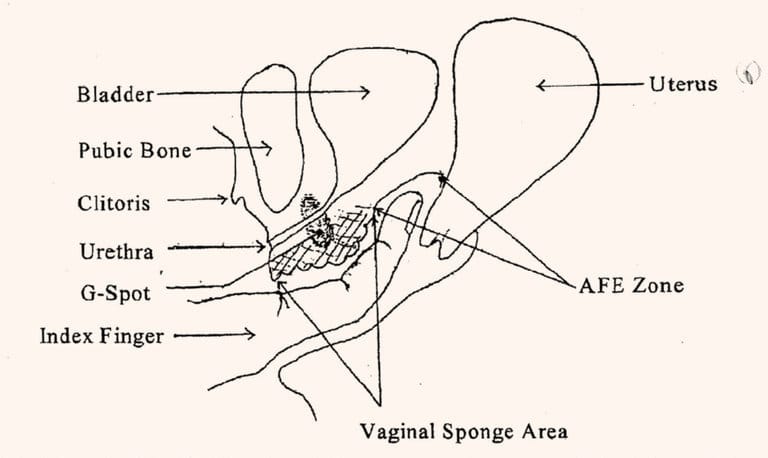
Both zones sit on the front wall of the vagina and both produce lubrication and arousal — but they are not the same area.
The G-spot sits two to five centimeters in. Spongy and ridged, it responds well to firm pressure. The A-spot is deeper — about six to ten centimeters in, just before the cervix. Smoother in texture, it responds best to light, repetitive strokes rather than deep pressure.
Lubrication at the A-spot tends to come faster and is often more consistent, especially with women new to internal touch. For a full picture of how these zones relate to each other, see the complete map of erogenous spots.
Self-Exploration: Dr. Chua's Home Practice
Dr. Chua designed a home practice for women to use on their own. His suggested position: squat or sit back with knees pulled close to the chest. From here, the index finger reaches the anterior fornix with ease.
Use the soft pad of your finger and apply the same short, repetitive strokes. Light touch and small movement are all you need. Daily practice for at least one week was his suggestion — each session takes only five to ten minutes.
Over time, the nervous system learns to respond faster. A woman who knows this area guides a partner with far greater clarity and confidence.
Why the A-Spot Matters in Yoni Massage
In yoni massage, the A-spot plays a specific role: it prepares the body.
Without enough lubrication and pelvic opening, deeper work can feel rough or irritating. Spending time on the anterior fornix early in a session ensures the body is fully ready for everything that follows.
This same idea drives deep pelvic lubrication through the P-spot — both zones activate fluid release through the vaginal walls. The A-spot adds an independent reflex path that works without mental arousal.
Many women describe sustained AFE zone stimulation as a deep, grounding sensation — different from clitoral or G-spot pleasure, and much more whole-body in quality.
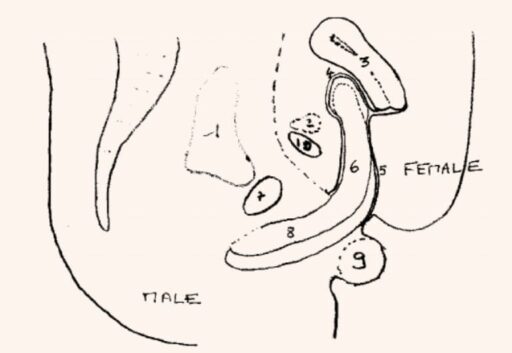
(1) Male bladder; (2) Female bladder; (3) uterus;(4) Anterior fornix; (5) Posterior vaginal wall (6) Erect part of the penis inside vagina; (7)Male pubis; (8) Root of the penis; (9) Testis; (10) Female pubis.
From article "Magnetic Resonance Imaging (MRI) of Sexual Intercourse: Second Experience in Missionary Position and Initial Experience in Posterior Position".
researchgate.net
Results and What to Expect
Dr. Chua’s results were clear. Over sixty percent of his patients reported a rise in lubrication and sensitivity. Around fifteen percent reached orgasm during their very first session.
Practitioners observe similar patterns in real sessions. When preparation is right and technique is correct, the response is fast and unmistakable.
Each session builds on the last. The nervous system opens more quickly and completely over time. Consistency matters more than intensity — short, regular sessions produce deeper results than rare, intense ones.
Working with a Partner
Once a woman knows her own AFE zone, she can share the technique with a partner. Dr. Chua saw this as a natural step — bringing real knowledge and care into intimate life.
Short nails, clean hands, slow movements, patient rhythm. Attention shifts from performance to genuine physical readiness. Both people share a language based on anatomy, not guesswork.
Many practitioners describe the A-spot as a doorway — not just to lubrication, but to trust, presence, and deep somatic connection.
The A-Spot as a Starting Point
The AFE zone is not a trick or a shortcut. It is a reliable entry point into the body’s own arousal system — one that works independently of mental state, stress level, or experience.
For practitioners, that reliability matters. It means the session can begin from a place of genuine readiness rather than forced arousal. For the woman, it means her body gets to lead.
Learning this zone is a foundational step in any serious yoni massage education. For those who want to go deeper with clear guidance and safe structure, our yoni massage training course covers the AFE zone in full practical detail.