

The human body is full of wonders, and few areas have caused as much interest as the G-spot. For decades, people have debated its existence, its location, and its function.
In yoni massage and somatic education, we look at this area not as a mystery, but as a gateway to deep feeling and body awareness.
To truly understand this zone, we must look at its long history and its physical structure. By combining old knowledge with modern practice, we can create a safer and richer experience for everyone.
Ancient Wisdom and the Ananga Ranga
Long before modern doctors began writing about female pleasure, ancient cultures were already recording the body’s sensitive zones. One of the most striking historical references comes from the 16th-century Sanskrit text known as the Ananga Ranga. This ancient Indian book on love describes the female body in great detail.
Dr. Shashank Samak of Pune presented a translation of this text at a specialized conference. He noted how the Ananga Ranga describes a specific sensitive point on the front wall of the vagina. This shows that healers hundreds of years ago were already aware of this spot.
Ancient texts about female anatomy remind us that what we call new findings are often old truths being remembered. Our bodies have always held these secrets — we are simply learning to read them again.
The 20th Century Rediscovery by Dr Ernst Grafenberg
The modern history of this zone began in the middle of the 20th century.
In 1950, a German doctor named Dr. Ernst Gräfenberg published an article on the role of the urethra in female orgasm. During his clinical work, he noticed a specific area on the front wall of the vagina that caused intense arousal when touched. He described how this area would swell during stimulation, much like other erectile tissues.
At the time, the medical world was not very interested in female pleasure. His research was largely ignored for many years. It took a long time for science to recognize the worth of his findings. What was forgotten is now central to somatic practice.
How the G-Spot Finally Got Its Name
It took thirty more years for Dr. Gräfenberg’s work to resurface.
In 1981, a group of researchers led by Addiego first used the term G-spot in a scientific paper “Female Ejaculation: A Case Study“. The authors named the area the G-spot to honor Dr. Gräfenberg.
In 1982, John Perry, Beverly Whipple, and Alice Kahn Ladas wrote a book titled The G Spot and Other Discoveries about Human Sexuality. This book became a global success and changed how the world talked about female anatomy. The book sparked a wide conversation and helped millions of women explore their own bodies with more confidence. A book that changes a public conversation is rare — this was one of those books.
Today the term is known worldwide, though its full physical complexity is still being studied.
Modern Science and the CUV Complex
Today, our scientific view of the G-spot has evolved. Many modern researchers do not see the G-spot as a single button or a separate organ. Instead, they describe it as a projection of several internal parts working together.
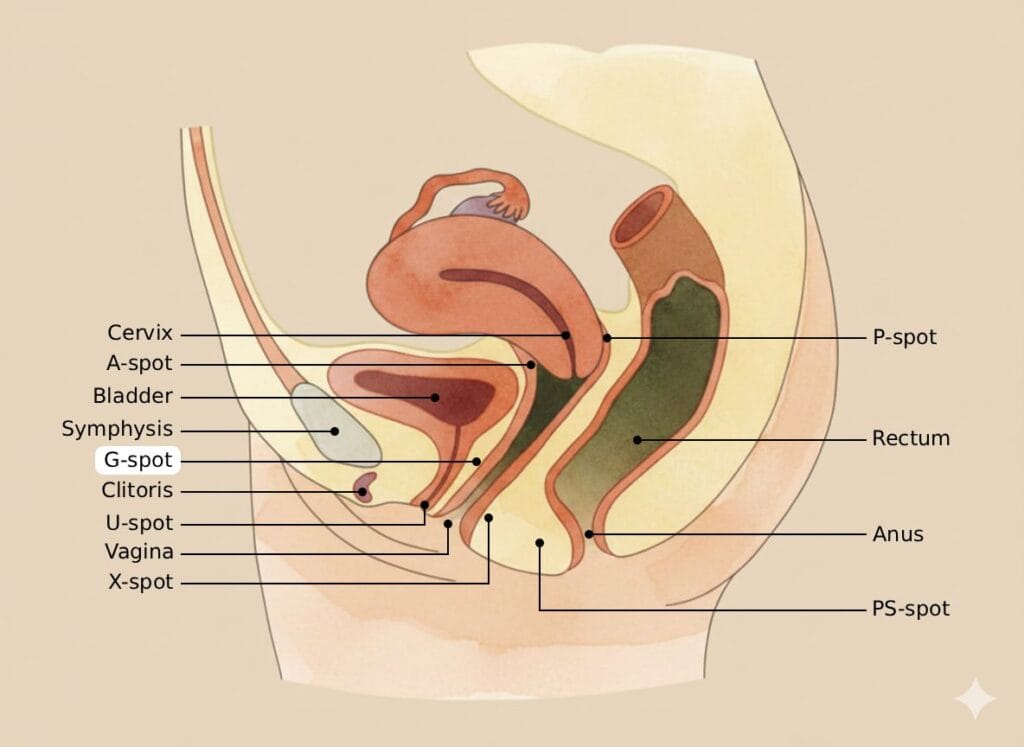
This is often called the CUV complex — Clitoral-Urethral-Vaginal complex. When we touch the G-spot, we engage with the internal parts of the clitoris, the clitoral bulbs and roots that wrap around the vaginal canal. This area is also deeply connected to the nerves of the urethral sponge and the female prostate.
It is a highly integrated zone where different tissues and nerve endings meet in a small space. This is why stimulation here feels so different from external clitoral touch. Every layer has its own story to tell.
Somatic Anatomy and the Textured Near Zone
In yoni massage, we approach the G-spot with care and presence. For learning purposes, we divide this area into two distinct parts.
The first is the near zone, located just a few centimeters inside the vaginal opening on the front wall. When you touch this area, it feels very different from the smooth walls of the rest of the vagina. It is ribbed and textured, often feeling more firm than the surrounding tissues.
Some people compare it to the roof of the mouth, others to the shell of a walnut. This texture exists because you are feeling the urethral sponge and the female prostate through the vaginal wall.
The same urethral sponge that creates this texture is also the anatomical basis of the U-spot — the sensitive zone just outside the vaginal opening. In yoni massage, we spend time simply meeting this texture with a soft finger, allowing the body to relax into the touch. This alone can be deeply meaningful.
The Softness of the Deep Zone
As you move slightly deeper past the textured area, the sensation changes. There is a point where the firmness ends and the finger falls into a softer space.
This is the deep zone of the G-spot, which offers a different kind of sensory feedback. It feels much smoother — almost like the inside of your cheek. This area sits near the neck of the bladder.
In yoni massage, the shift from firm texture to soft depth is very important to notice. It calls for careful presence and adjustment of pressure. Both the textured area and the soft deep area are filled with a complex web of nerve endings.
The body rewards patience here. Rushing past this transition means missing some of the richest territory on the map.
Following the Bodies Unique Map of Sensitivity
Because the G-spot is a complex intersection of nerves, there is no single right way to touch it. Some nerve endings respond to deep pressure, while others respond better to light vibration. Every person has a different map of sensitivity that changes over time.
In a somatic yoni massage session, we do not follow a fixed routine or look for a specific result. Rather than following a script, we read the body’s reactions and listen to the nervous system. We look for small changes in breath, muscle tone, or skin color.
Body tension is a sign to slow down or return to a simpler touch. Softening and swelling of the tissues is a sign that the nervous system feels safe and open. Each session is a fresh conversation with the body — and the G-spot orgasm is just one of the full spectrum of orgasm types the body can experience.
Essential Techniques for Somatic Exploration
When the body is ready, there are several ways to engage with the G-spot area. We always start with the most gentle movements to build trust before going deeper.
- “Drumming” involves very light, rhythmic tapping on the textured area with a soft fingertip — like a soft heartbeat that sends gentle signals to the brain.
- “Wide circles” involve using a flat finger to make slow, wide circular movements around the entire ribbed area, helping blood flow to the whole zone.
- “Deep compression” involves a soft but firm press of the G-spot area upward toward the pubic bone, creating a steady contact that engages the deeper structures.
- “The come-hither” move is a classic somatic motion where the fingertip mimics a beckoning gesture against the front vaginal wall, encouraging the tissues to open.
Each of these movements speaks a different language to the nervous system.
Vasocongestion and the Third Perinatal Matrix
As stimulation continues, blood flows into the tissues, causing them to swell and become much more sensitive to every touch. This swelling process is called vasocongestion and it is a sign of arousal and readiness for more intense somatic work.
When the tissues have become soft, warm, and swollen, the practitioner can move to more dynamic work.
This can help a woman experience an intense energy release that spreads through the whole body. Such a release often connects the physical sensations to a deeper emotional layer. It makes the experience feel complete and lasting.
Understanding Fluids and Emotional Release
Intense stimulation of the G-spot area can lead to the release of fluids. In the context of yoni massage, this is seen as a healthy and natural part of the body’s response.
Two types of fluid can be released during this work. Squirting is a clear, watery fluid that comes from the bladder area. It often happens during a sudden peak of arousal when the muscles relax fully. Female ejaculation is a thicker, milky fluid that comes from the female prostate.
Both are normal and safe. Many women feel shame or confusion about these fluids, but in a safe somatic space we welcome them as signs of deep release and restored natural flow.
To learn how to work with the G-spot and all related zones in a safe and step-by-step way, join complete yoni massage program.