
Beverly Whipple did not plan to change science. She started as a nurse, helping women with urinary problems.
During that work, she and colleague John Perry noticed something odd: some women with very strong pelvic muscles said they released fluid from the urethra during sex. This small finding would reshape how the world sees female anatomy.
For yoni massage practitioners, her legacy is not just old history — it is the scientific base for much of the internal work done in every session.
From Nursing to Sexology
Whipple built her career at Rutgers University and became Professor Emerita there. Her nursing background shaped how she did research: she cared about what women actually felt, not what textbooks said they should feel.
When she and Perry began studying fluid release during orgasm, they did not treat it as a problem. They measured it with care. Their findings showed that women who described ejaculation had far stronger pelvic muscles than those who did not.
This careful, respectful approach to women’s lived experience became the core of all her later work. She believed that real science starts with listening.
The 1981 Study That Started Everything
In 1981, Whipple co-authored a paper with Frank Addiego and others in the Journal of Sex Research: “Female ejaculation: a case study”.
This was the first science paper to use the term G-Spot.
Their team studied over 400 women and found a tender spot on the front wall of the vagina, halfway between the pubic bone and the cervix. When touched with a curved motion — two fingers, palm up — this area would swell. In some women, fluid then came from the urethra. Women said it looked like watered-down milk, tasted sweet, and was about a teaspoon in size.
That landmark case study of female ejaculation gave the whole field its first solid ground.
The Book That Changed the Conversation
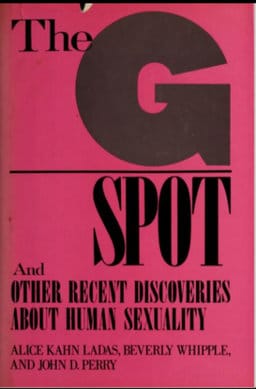
In 1982, Alice Kahn Ladas, Beverly Whipple, and John Perry released book “The G Spot and Other Recent Discoveries About Human Sexuality”. It was based on their three papers from the year before.
What happened next was not expected: the book became a global bestseller, made the New York Times list, and was put into 19 languages. It brought female ejaculation back into medical and public talk after many years of silence.
Critics were loud — Rebecca Chalker noted that the book met with scorn and doubt. Still, millions of readers learned for the first time that an internal erogenous zone had been ignored by science for decades.
The debate was fierce, but the door was now open.
Book Cover
wikipedia.org
Naming the Gräfenberg Spot
The term G-Spot first appeared in that 1981 paper, but the 1982 book spread it across the world.
The six co-authors chose the name with care: they wanted to honor Ernst Gräfenberg, a German gynecologist who in 1950 wrote about a tender area near the urethra and a fluid that was not urine.
A deeper look at the life and research of Ernst Gräfenberg shows he never named this zone after himself — the research team did it to give him credit. Naming the zone was not a claim of discovery. It was an act of restoring lost knowledge to its rightful place in science.
Female Ejaculation as a Normal Phenomenon
One of Whipple’s clearest contributions was showing that female ejaculation is a normal part of healthy sexuality, not a sign of incontinence.
Lab tests of the fluid backed this up. Ejaculate has high levels of PSA, glucose, and fructose — and very low levels of urea. Urine shows the reverse pattern.
From 1986, Whipple worked closely with Slovak researcher Milan Zaviacic, who had found on his own that this fluid comes from the female prostate gland. Their work together over nearly 30 years built a strong case that female ejaculation is a glandular event, not a bladder leak.
The Controversy and the Critics
Debate about the G-spot was never calm. In 2010 and 2012, the Journal of Sexual Medicine ran reviews saying the G-spot is not a single body part.
Whipple’s reply was simple: no one ever claimed it was.
It is a zone where several tissues meet — the front vaginal wall, the urethra, the female prostate (the Skene’s glands), nearby muscle, and parts of the inner clitoris. Researchers including Jannini later called this zone the clitourethrovaginal complex, or CUV.
Her work helped make the CUV framework the most honest way to describe what somatic practitioners had seen for years.
wikipedia.org
The Vagus Nerve Discovery
Beyond the G-spot, Whipple made another key finding: orgasm can reach the brain through the vagus nerve, skipping the spinal cord.
Using fMRI scans, her team showed that women with full spinal cord injuries could still have orgasms through mental focus alone. This confirmed what somatic teachers had long believed — pleasure is not just a local reflex in the pelvis. Her lab work also helped isolate a brain chemical linked to arousal and blood flow.
These discoveries pushed the map of female pleasure far beyond the pelvic region. The body, it turns out, has many paths to joy.
Whipple's Philosophy: Process Over Goals
In her 2015 review paper, Whipple said her goal was simple: to confirm that what women report feeling is real, not to create new spots or targets.
She believed women should feel free to enjoy pleasure in many ways, without a fixed list of things to reach. Good sexual health starts with self-acceptance and focus on the process, not the result.
This fits the core values of yoni massage very well. Sessions do not promise orgasm or fluid release. They offer awareness, safety, and calm presence. These are the same values Whipple defended in her lab for decades.
Legacy for Yoni Massage Practice
Whipple gave somatic teachers both language and science to work with.
Knowing the G-zone today means knowing the full CUV complex, and her work helped draw that map. Her clear split between female ejaculate and squirting remains vital for honest teaching in yoni massage.
She did not work in isolation — a broader look at the pioneers who shaped the history of yoni massage shows how her research sits alongside the work of Gräfenberg, Zaviacic, Masters and Johnson, and others who built the field piece by piece.
More than anything, her drive to record what women actually feel — not what old male-centered models said they should feel — is the same drive that shapes ethical somatic work today. When a practitioner moves slowly and with full care on the front wall of the vagina, they are working on the ground that Beverly Whipple spent her life making solid.