

Most people who know the AFE zone do not know the name of the man who found it.
Dr. Chua Chee Ann is a Malaysian physician who spent decades working with women who had no good answers for their pain. His search for one led him to a discovery that changed how we understand the female body.
The story of how he found the AFE zone — and why it took him years to tell it — is one of the more unusual chapters in somatic anatomy.
A Physician Who Listened to His Patients
Dr. Chua graduated from the University of Malaya as a medical doctor in 1972. Seven years later, he completed a Master in Public Health in the USA, with a focus on sexual health.
He then built a practice in reproductive health care for women. Many patients came to him with the same problem: dry, painful sex that did not respond to standard treatment. Pills and gels gave only short relief. He prescribed what was available, watched patients return with the same complaint, and kept looking for something better.
Dr. Chua believed the body itself had an answer — one that could be activated directly, without needing mood, hormones, or mental arousal.
The 1985 Congress and the Turning Point
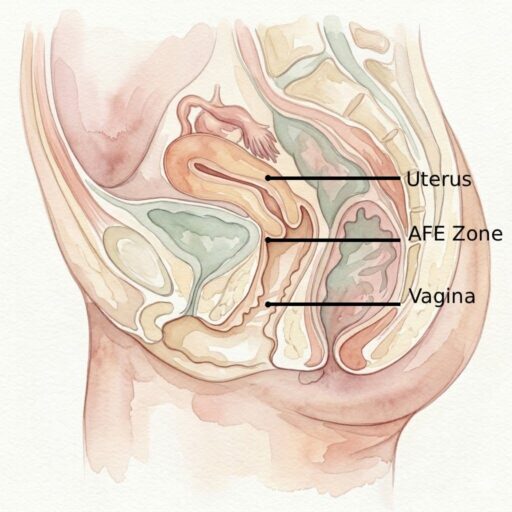
In 1985, Dr. Chua attended the 7th World Congress of Sexology in New Delhi. A video on female ejaculation during G-spot orgasm caught his attention. He left with one question: if the female body could release fluid during orgasm, could that same reflex solve the problem of vaginal dryness? This became the focus of his next eight years. Working in territory no one else had mapped, he began studying the anterior wall of the vagina, looking for a zone that could produce a lubrication response on demand.
The 1989 Experiment
In 1989, a 48-year-old woman agreed to be Dr. Chua’s first trial participant. The results were striking. With the right sequence of touch, her vagina lubricated on demand — regardless of mood or arousal. A local reflex in the vaginal tissue had bypassed the brain entirely. This was not what standard models predicted. From 1989 to 1993, Dr. Chua ran a clinical trial on 271 women. Results were clear and consistent across all participants. He now had the data to support what he had first observed in one room with one volunteer. His approach drew on the same territory that researchers like Beverly Whipple had begun to map — but pushed it in a completely different clinical direction.
Rio de Janeiro 1993: Going Public
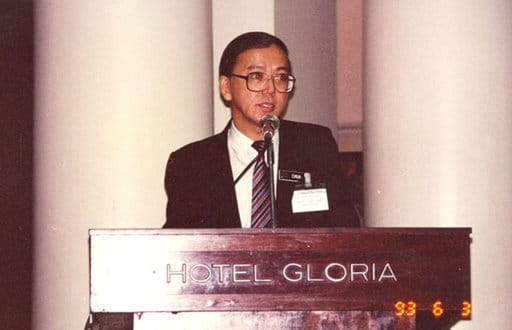
On June 3rd, 1993, Dr. Chua presented his findings at the 11th World Congress of Sexology in Rio de Janeiro. He named the zone the Anterior Fornix Erogenous Zone — AFE Zone, or A-spot. A workshop followed where he showed the technique to colleagues from around the world. Sexologists noted the discovery. But the technique required direct manual contact with the vaginal wall — a step most practitioners and ethical codes could not follow. Discovered and noted, the technique still did not travel far beyond that room.
Why He Waited 13 Years to Speak
In a 2006 interview, Dr. Chua explained his long silence after Rio. He gave three reasons.
- First, the media had focused only on the zone and missed the technique — which he saw as more important than the anatomical finding itself.
- Second, he wanted time to verify safety and consistency before sharing the method widely.
- Third, he had waited for other researchers to confirm his results. Nobody did.
After 13 years, he decided to bring the work forward himself and share it directly with women and practitioners through his own platform.
The Local Reflex Mechanism
The core of Dr. Chua’s finding was not just a new zone. It was a new model of how lubrication works. Standard thinking held that the brain processed all arousal signals and lubrication followed desire.
Dr. Chua found a different path: a local reflex that could produce lubrication in seconds, without a brain signal. He compared it to the hand that pulls away from a hot surface before the brain registers pain. In the same way, the anterior fornix responds to the right touch before the mind has formed any thought.
This meant a woman’s body could prepare for sex on its own terms — independent of her emotional or mental state.
Vaginal Dryness as a Medical Problem
Dr. Chua showed that vaginal dryness was a physical problem with a physical solution. Poor lubrication causes tissue tears, pain during intercourse, and in serious cases damage to the urethra and surrounding pelvic structures.
Many women with recurrent urinary infections had a cause their doctors were not seeing — chronic dryness during sex. His technique gave a direct answer.
A woman could activate the AFE zone reflex herself, preparing her body in under a minute, without waiting for mood or arousal. She did not need a partner or a prescription to do it. This independence was central to what made the method radical.
Why His Research Was Not Replicated
Dr. Chua was clear about why his work did not spread through formal channels. Most clinical settings could not allow direct contact with the vaginal wall.
A pelvic model could teach the technique without this contact — but few practitioners made the effort. In his view, colleagues lacked the courage to follow where his research pointed.
Years passed without anyone stepping forward to test or confirm his findings in a formal setting. He accepted this without bitterness — some discoveries move forward through practitioners rather than through institutions.
His Legacy in Somatic Practice
Dr. Chua published his paper in the British Journal of Sexual and Marital Therapy in 1997. In 2006, the American Biographical Institute named him one of the 500 Greatest Geniuses of the 21st Century — alongside figures such as Albert Einstein and Nelson Mandela.
Beyond these formal marks, his real contribution is the understanding of the anterior vaginal wall he helped create.
Today, the AFE zone is a recognized part of somatic anatomy, and the reflex lubrication model he described shapes how practitioners think about readiness and sensitivity in intimate work.
To see how this anatomy is applied in practice, visit our complete yoni massage program.