

The clitoris has been discovered and lost more times than almost any other structure in anatomy. It was drawn, named, and then erased. This happened again and again. Sometimes within a single century.
This pattern was not random. It showed how medicine treated the female body for most of its history. For anyone who works with yoni massage, this story reveals why certain knowledge took so long to arrive — and why it still matters today.
Vesalius and the Denial of the Clitoris
Andreas Vesalius was one of the most powerful scientists of the 16th century. His reach lasted for generations.
Yet he denied clitoris existed. In his view, the female body was a version of the male — each part inverted. The penis matched the vagina. There was no room for it.
When colleagues described it, he dismissed their work. Most scientists did not challenge him. His denial set the tone for years to come.
Colombo and Falloppia — Who Really Discovered It
Two of Vesalius’s peers were busy describing the clitoris while he denied it. Realdo Colombo and Gabriele Falloppia both claimed credit for its discovery. Their dispute became one of the more entertaining arguments in anatomy history.
Colombo gave it several poetic names — including amoris dulcedo, sweetness of love. Falloppia responded sharply. He said modern scientists had entirely neglected the structure, and that whatever others had written, they had taken it from him.
Both men worked from direct observation. The argument was never resolved, but it placed the organ on the anatomical map — at least for a time.
De Graaf and the First Comprehensive Description
In the 17th century, the Dutch scientist Reinier de Graaf wrote the first truly complete description of clitoral anatomy. His work was precise where others had been vague. The bulbs sit on either side of the vaginal opening. They were described and given a role in sexual response.
In 1672 he wrote that he was surprised. Some scientists made no mention of it at all — as if it did not exist. Yet in every body he had cut open, it was clearly present to both sight and touch. His detailed work on the female pelvis shaped how later scientists understood the whole region.
Kobelt — The Most Detailed Description Before MRI
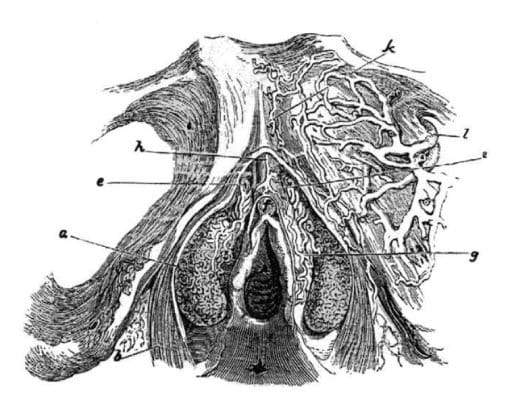
Georg Ludwig Kobelt worked in the 1840s. He produced the most detailed description of clitoral anatomy before modern imaging. Cutting and injection studies were used to trace the blood supply of the organ.
His description covered the body, the glans, the bulbs, the muscles, and the blood flow. He noted that the nerve trunks entering the glans were very thick. One could barely imagine how such a mass of nerve tissue could fit within such a small structure. His drawings were detailed and exact.
When MRI studies came over 150 years later, they found that Kobelt had been right. Modern tools confirmed rather than corrected his work.
wikipedia.org
The Terminology Problem — What Was the Clitoris Even Called
One reason the clitoris kept vanishing was that its name was not stable. Hippocrates called it columella — little pillar. Avicenna named it virga — rod. Another writer used tentigo — tension.
The word clitoris itself did not appear in English until the 17th century. Its origin is still disputed. Some link it to a Greek word meaning to rub. Others link it to a word for hill.
For centuries, the same parts were called by different names in different places. The same names were used for different parts in different texts. De Graaf argued for using only the word clitoris — every time — to end the confusion. That effort took far longer than it should have.
Why the Clitoris Kept Disappearing From Textbooks
One of the strangest facts in anatomy history is that the clitoris was not simply unknown. It was known, described, and then quietly removed. Details present in early 20th century anatomy diagrams were later cut from newer editions.
This was not by accident. It was active deletion. Pages were given to the penis in standard texts. It received less space with each new edition. This was not a neutral gap. It showed a medical culture where female sexual anatomy was seen as less worth studying.
The result was a hole in knowledge that lasted for over a century.
Carol Downer and the Feminist Anatomy of 1981
In 1981, Carol Downer led the writing of A New View of a Woman’s Body, released by Simon and Schuster. Rebecca Chalker edited it. It was the first medical book to illustrate the full female anatomy. The clitoris was shown in complete form — bulbs and urethra included, drawn as part of one connected system.
Medical textbooks of the time showed far less. The feminist health movement produced something more accurate than mainstream medicine had managed. Their diagrams were dismissed as political rather than scientific.
Yet decades later, when O’Connell published her MRI findings, the anatomy matched what Downer and Chalker had already drawn. The body had been right all along.
What Modern Science Finally Confirmed
When O’Connell began her work in the 1990s, she was not finding something entirely new. She was bringing back what had been known, lost, and known again across centuries.
Her MRI studies confirmed what Kobelt had drawn and De Graaf had described. Large and complex, it is closely linked to the urethra and vaginal walls.
What she added was clear imaging that modern medicine could not dismiss. The full anatomy is now on record in a form that will not be easily lost again.
Why This History Still Matters for Yoni Massage Today
Knowing this history changes how a practitioner approaches the female body. The gaps in medical knowledge were not neutral. What was taught changed because of them. Women were told less about their own bodies for generations because of them.
Yoni massage works with the body as it actually is — not as centuries of selective attention chose to describe it. A practitioner who knows the full extent of the clitoris touches with a different kind of awareness. Its internal reach matters — and so does its link to the pelvic system. That awareness is grounded in a lineage of careful observation. It was repeatedly suppressed — and just as repeatedly recovered.
Practitioners who want to build this anatomical and somatic foundation can find a structured path inside the online yoni massage course.