

Beyond the body parts we can see and touch, old traditions describe a complex system of subtle pathways.
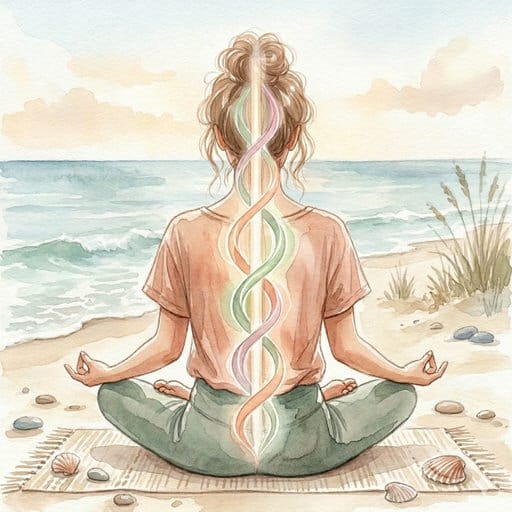
Energy moves through channels known as nadis in these invisible layers. In Sanskrit, the root “nad” means a flow that feeds and holds all life.
Where Western medicine studies nerve fibers, the study of nadis looks at the inner space of lived experience — where every emotion and thought has its own path of movement. This inner map has shaped somatic practice for thousands of years.
The Scale of the Subtle Network
The scope of this system is vast. Old texts mention between 72,000 and 350,000 channels in the human body.
Yet most practices focus on three main paths: Sushumna, Ida, and Pingala. These act as the core routes for rising energy, sending vital resources through the whole body.
Knowing these three channels is key to managing one’s state during somatic sessions and yoni massage. Without this knowledge, a practitioner works only with the surface of what the body can offer. Going deeper always requires knowing the full map well.
Ida: The Lunar Current of Stillness
Ida starts to the left of the base of the spine. It works as a cooling, passive force, linked to the rest state of the nervous system. Through this channel flows lunar energy — the energy of intuition, the inner world, and the ability to rest deeply. When Ida is strong, a person feels calm and open.
This state is key for a woman to surrender the need for constant action and move into a space of deep somatic listening. It gives the nervous system the space it needs to restore and release held tension.
By waking up this lunar current, the body stops its usual defense and begins to open. Touch can then be felt without any pressure to respond. This is one of the most important shifts in somatic work.
Pingala: The Solar Force of Action
Pingala starts to the right of the spine and links to the active branch of the nervous system. This is a hot, active energy needed for outer effort, focus, and physical drive. It is often seen as a masculine force that governs logic and expression.
Balancing Pingala is vital — without it, a session feels too slow and flat, but too much leads to stress and tension. When this channel is used well, touch becomes a conscious meeting with bodily feeling rather than a routine act.
Each session needs both channels to find its own right balance.
Sushumna: The Central Pillar of Light
Sushumna is the main channel that runs through the center of the spine and passes through all the chakra points. It is seen as the most key of the three, bringing harmony to the poles of Ida and Pingala.
Awakened energy rises through Sushumna from the pelvic floor to the crown of the head. When this channel becomes active, one moves past the usual split of pleasant and unpleasant, and enters a state of whole, unified presence.
Most people report this shift as a sudden sense of deep peace and expanded awareness.
Breath as a Regulator of Flows
The state of our energy channels shows directly in how we breathe. Old masters noticed that at any given moment, one nostril breathes more freely than the other — this signals which channel is more active.
By changing the breath pattern with care, we can shift our inner state. This makes breathwork the main tool for building safety and calm before and during somatic sessions.
The breath is the most direct key we have to the energy system. Every serious practitioner learns this early on.
Nadi Shodhana: The Art of Purification
One way to balance the channels is through Nadi Shodhana, also called alternate nostril breathing. By closing one nostril and breathing in through the other, we bring the left and right sides of the brain into sync.
This technique is a method for liberating energy paths from stagnation, clearing the mental and emotional noise that blocks the free flow of sensation.
It prepares the body for a deeper somatic experience by settling the nervous system before focused work begins. Many practitioners use it as the opening step of every session.
The Role of Breath Retention
In advanced practice, Kumbhaka — breath retention on the inhale or exhale — is used to direct energy into the central Sushumna channel. This takes a high level of inner focus and helps stabilize the free flow of life force.
In somatic sessions, a simpler form of this principle is the energetic movement through the central channel, which uses full-body tension to push energy upward. It trains the mind to stay still and calm even during strong inner events.
Over time, this becomes a natural state rather than an effort.
Awakening Through Physical Activation
In yoni massage, activating the nadi channels before focused work begins is very important. A full-body massage always includes firm rubbing of the base of the spine for this reason. Heat from this friction opens the entrance to Sushumna.
A simple step like this helps quiet the mind and shift the recipient’s focus from thinking to direct body sensation. It is a bridge between the outer and the inner world. Without this warm-up, the deeper layers of the session are much harder to reach.
Unity of Channels and Experience Integration
When the solar and lunar currents are in balance, energy moves naturally into the center. This is not just a physical event — it is a basic shift in how reality is felt. It allows the person to bring together what they have lived through, turning scattered sensations into one clear picture.
This kind of balance makes sure that the deep somatic changes from a session stay with the woman as a real shift in her daily life, not just a memory that fades.
If you want to explore this work in a safe and guided setting, the online yoni massage course offers step-by-step somatic guidance for practitioners.