

The female body contains many special zones that prepare the nervous system for deep relaxation.
One of these vital areas is the V-spot, which is also known as the vaginal vestibule.
This area is much more than just a simple entrance to the body. It is a complex and highly sensory zone where the transition from external touch to internal pleasure begins. In the practice of yoni massage, understanding this specific area helps a person open the path to deeper states of being without causing any stress to the system.
This gateway must be treated with extreme care and patience. When we honor the vestibule, we show the body that it is safe to open up. This creates a foundation of trust that lasts throughout the entire session.
What is the V-Spot?
The name V-spot comes from the Latin word “Vestibulum,” which means an entrance hall or a porch.
In medical terms, it is the space located between the labia minora. This zone is strictly defined by physical landmarks. On the outside, it begins at a visible line on the labia minora. At this exact line, the skin clearly changes its color and texture. Its sides are formed by the inner surfaces of the labia minora, while the top boundary is marked by the clitoris. The lower part is bounded by the frenulum of the labia minora, often called the fourchette. Moving inward, the deepest part of this space is marked by the hymen or its natural remnants.
You can think of it as the “front room” of the sacred female temple. This area contains the openings for both the urethra and the vagina. It is a very delicate region covered by a thin layer of skin. Because it is so sensitive, it reacts quickly to changes in temperature, moisture, and pressure.
Before a practitioner can move to deeper internal work, this “front room” must be completely relaxed and comfortable. If the vestibule is tense, the rest of the body will likely stay closed as well.
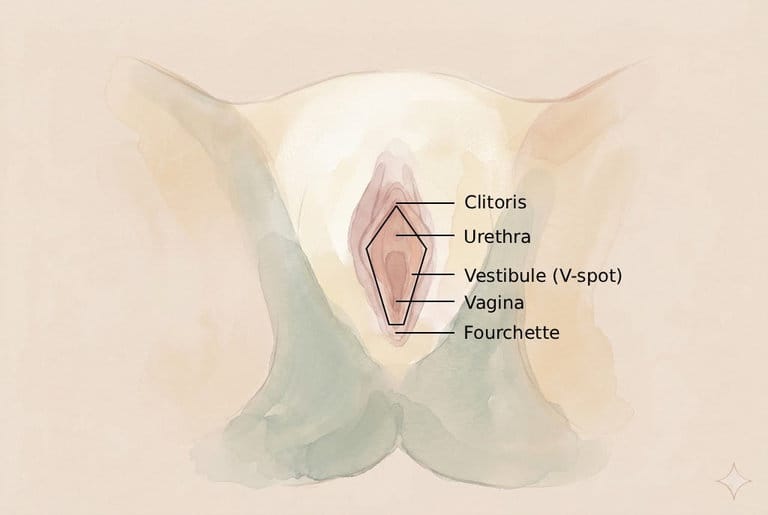
Anatomy of the Vaginal Vestibule
The anatomy of this zone is quite detailed and often misunderstood. It includes the urethral opening, the vaginal opening, and the surrounding glandular tissues.
Central to this area is the female prostate, a complex system of glands that wrap tightly around the urethra from all sides. Modern research by experts like Dr. Milan Zaviacic has shown that these glands are not just two isolated points, but a rich functional network.
Additionally, the vestibule contains the Bartholin’s glands. These glands produce natural lubrication. It is important to note that the Bartholin’s glands are located deep within the tissues. Because of this deep location, they are not massaged directly during a yoni massage session.
Preparing the Gateway: Indirect Stimulation
In a professional yoni massage, the V-spot is usually massaged using an indirect approach. This means we do not start by touching the most sensitive parts immediately.
We begin by working on the surrounding areas to slowly “wake up” the nervous system. The first step involves very gentle rubbing of the labia minora. This light friction improves blood flow to the entire vestibule area. As the blood moves into the tissues, they become warmer and more sensitive.
This slow preparation prevents the body from feeling shocked by sudden touch. It is a way of asking for permission before entering a very private space.
The Role of the Clitoris in V-Spot Activation
The massage also includes a brief focus on the glans of the clitoris. However, there is a very important rule to follow here. The practitioner must massage the clitoris for only a short amount of time.
The goal is not to cause a local clitoral orgasm right at the start. If an orgasm happens too early, the area can become oversensitive. This high sensitivity can make it impossible to continue the massage or reach deeper internal zones.
Our real goal is to create a gentle sense of arousal that flows through the whole body. We want to build energy slowly rather than releasing it all at once.
From the U-Spot to the Vaginal Opening
After preparing the outer areas, the practitioner moves closer to the center. We use slow, circular motions starting from the clitoris and moving down toward the urethra. This is the area of the U-spot. It is helpful to visualize the u-spot diagram to understand exactly where this stimulation happens.
By connecting these points with a continuous line of touch, we prepare the tissues for expansion. This movement creates a bridge of sensation that leads directly to the vaginal opening. It helps the woman stay connected to her physical feelings as the touch moves from the outside to the inside.
Stretching the Vestibule: The Art of Waiting
When it is time to begin the internal part of the massage, we do not simply push inside. We start by gently stretching the entrance.
The practitioner inserts one finger only up to the first knuckle. Then, the finger is moved slowly to the left side to stretch the tissue.
Here is the most important part: the finger must stop moving. You must wait for at least thirty seconds without any wiggling. This pause gives the tissues the time they need to release their own tension. It allows the body to “invite” the finger in rather than feeling forced. This method respects the body’s natural pace of opening.
Expanding the Compass: PS and G-Spot Origins
Once the left side feels relaxed, we repeat the process in other directions. We move the finger to the right side and wait again for thirty seconds while breathing deeply.
We also stretch the lower part of the entrance, which connects to the PS-spot. Finally, we move toward the upper part of the entrance, where the G-spot begins.
Each of these pauses is a vital key to building somatic trust. By waiting and breathing together, the practitioner and the woman create a shared rhythm. This slow expansion ensures that the V-spot remains soft and receptive throughout the entire experience.
The Earth Movement: Deep Grounding Touch
Rest your four fingers on the outside of the thighs for good support. Place your thumbs just above the vaginal opening. Softly press your thumbs deep into the tissue. Stop moving and hold this steady pressure. Take a few slow breaths together. Then, slowly release the pressure of your thumbs.
Move them just a few millimeters higher. Press gently into this new spot and take a few more breaths. Keep moving up with these slow steps. Travel from the vaginal entrance to the area just above the clitoral hood.
This technique is known as the Earth movement in yoni massage. It uses heavy and dense pressure. It feels like a thick, safe layer of earth resting on the body. You may remember this grounding touch from the full body massage. Now, it brings deep safety and calm to this highly sensitive zone.
The Mystery of Female Prostate and Ejaculate
The V-spot area is closely connected to the female prostate. During a deep yoni massage, the practitioner might notice a thick, white fluid appearing in this zone. This is female ejaculate, and its chemical makeup is somewhat similar to male fluid.
This is a completely natural and healthy reaction of the body. It is a sign that the internal glands, which surround the urethra, are being deeply activated. Seeing this fluid shows that the body is moving into a state of high arousal and deep release.
The practitioner continues the work without interruption, staying focused on the physical sensations and the flow of energy.
The Golden Rule: Why We Never Rotate Fingers Inside
There is a very strict rule for safety during this part of the massage. A practitioner must never rotate their fingers while they are inside the vaginal entrance. It is also vital not to stretch too hard in an upward direction.
This is because of the symphysis, which is the hard pubic bone located right above the area. If a practitioner rotates their finger, their knuckle might press hard against this bone. For the woman, this causes a sharp, sudden pain. This pain can instantly put her into a state of stress. It activates the “fight or flight” response of the sympathetic nervous system.
To avoid this, we always use a “insert, stretch, wait, and remove” pattern.
Conclusion
Understanding the V-spot is about more than just physical touch. It is about learning to communicate with the body’s most delicate gateway. By following a slow and mindful pace, the practitioner helps the woman release deep-seated tension and enter a state of true somatic openness.
This process requires patience, observation, and a deep respect for the body’s natural boundaries. You can join our yoni massage course to learn the full sequence of these professional techniques.
Mastering these simple yet profound methods allows for a much more ethical and effective practice that supports the overall well-being of the woman.