

For a very long time, medical science ignored the existence of a specific prostate gland in the female body. Most textbooks focused only on the male version, leaving a large gap in our understanding of women’s health. However, dedicated researchers like Milan Zaviacic proved that women possess a fully functional prostate organ. This small but powerful gland plays a vital role in sexual health and fluid production. By learning about this anatomy, we can better understand the deep sensations that arise during a session of yoni massage.
Structural Differences Between Genders
The main difference between the male and female prostate is where the tissue is located. In men, the gland completely surrounds the urethra like a solid ring. In women, the prostatic tissue is located directly inside the walls of the urethra itself. Because of this internal location, the female prostate is naturally smaller and harder to see with the naked eye. This physical difference caused many early scientists to miss the organ entirely during their studies.
The length and thickness of the urethra limit the total size of the gland in women. Even though it is smaller, it contains all the necessary parts like glands, ducts, and smooth muscle. These components allow the organ to produce fluids and respond to neural signals. Understanding this structure helps us appreciate how the body is wired for complex sexual responses. It shows that both men and women share similar biological equipment for pleasure.
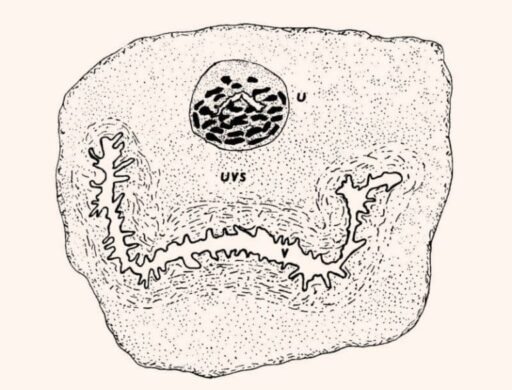
From the book "The Human Female Prostate" by Milan Zaviacic.
The Cellular Equipment of the Gland
Despite its small size, the female prostate is a complete functional organ with specific jobs. It is equipped with specialized cells that produce prostate-specific antigen, also known as PSA. This is the same protein found in the male prostate, proving the two organs are biological twins. The gland also features a network of smooth muscles that help move fluids through the small ducts. This knowledge is part of learning the map of erogenous zones that helps women connect with their bodies.
The female prostate is not just a passive structure; it has active endocrine functions. This means it can release chemicals that influence the mood and the nervous system. These findings are very important for doctors who study the urinary and reproductive systems. When we acknowledge the gland as a functional organ, we open new doors for pelvic health. It changes how we view the physical sensations that happen deep within the pelvic floor.
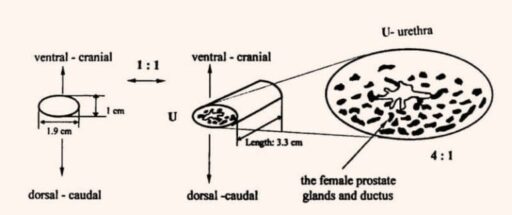
From the book "The Human Female Prostate" by Milan Zaviacic.
Visualizing the Hidden Tissue
Scientists use special dyes and markers to make the prostatic tissue visible under a microscope. One of the most effective methods involves looking for the PSA protein in the cells. Another method uses specific markers to highlight the protective layers of the glandular tissue. These tests allow researchers to see exactly how much prostate tissue a woman has.
It turns out that the amount of tissue can vary greatly from one person to another. Some scientific tests only show the glands, while others can show the small ducts that carry fluid. By using these advanced tools, experts can map out the different types of prostate configurations. This research has shown that nearly every woman has at least some prostatic tissue.
The Anterior or Meatal Type
The most common version of this organ is known as the anterior or meatal type. In this configuration, the majority of the prostate tissue is found near the entrance of the urethra. About sixty-six percent of women have this specific type of anatomy. It is characterized by a high concentration of glands located just behind the external opening. This makes the area near the entrance of the yoni particularly responsive to gentle touch.
In this type, the glands are often surrounded by a large amount of protective fibrous tissue. This structure provides a solid base that can be easily stimulated during a session. Because so many women have this type, it is considered the standard model for the female prostate. Practitioners who understand this anatomy can focus their attention on the areas where the tissue is most abundant. This knowledge makes the practice more effective and respectful of the body’s natural map.
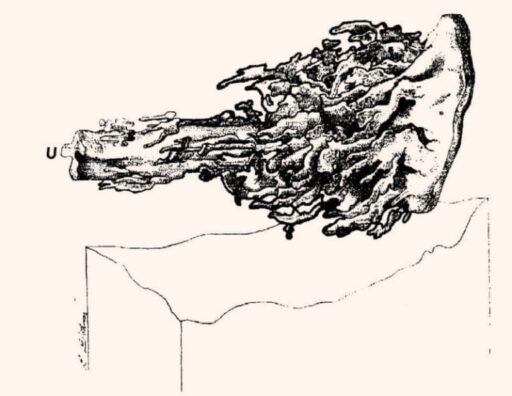
From the book "The Human Female Prostate" by Milan Zaviacic.
Posterior Configuration and the G-Spot Link
About ten percent of women have what is called the posterior type of prostate. In these cases, the prostatic tissue is most abundant near the neck of the bladder. This area is located deeper inside the body, further away from the external opening. This type is very interesting because it matches the location of the famous G-spot.
Some researchers believe that the G-spot is actually the internal sensation of the female prostate being touched. When this area is stimulated, it can trigger a powerful release of energy and fluid. This connection explains why different women prefer different types of internal pressure. Knowing your specific anatomy can help you communicate your needs more clearly during a session.
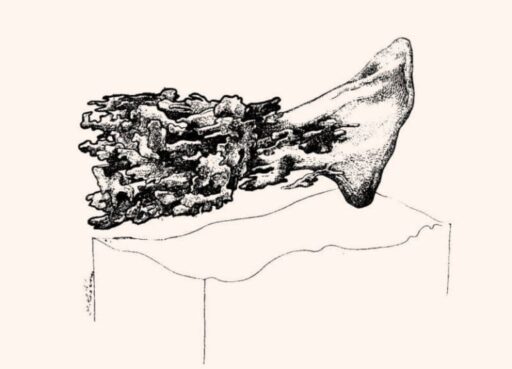
From the book "The Human Female Prostate" by Milan Zaviacic.
Full-Length and Rudimentary Variations
A small number of women have prostate tissue that spreads along the entire length of the urethra. This is known as the full-length type, and it offers a very wide area of sensitivity. While this type is rare, it is often shown in textbooks as the “classic” example. For these women, almost any touch along the urethral wall can trigger a somatic response.
There is also a rudimentary type, which is found in about eight percent of cases. In this version, the glands and ducts are very small and scattered. However, even with a rudimentary prostate, the organ is still present and functional. This proves that every woman has the biological potential for prostatic release, regardless of her specific type.
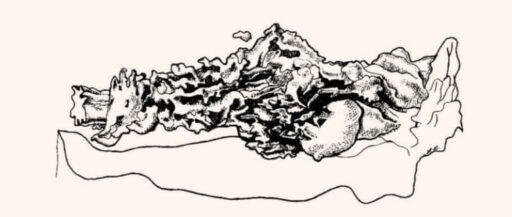
From the book "The Human Female Prostate" by Milan Zaviacic.
Middle and Dumbbell Configurations
There are even rarer shapes of the female prostate, such as the middle or dumbbell types. In the middle type, the tissue is concentrated in the center of the urethral wall. The dumbbell type has two main clusters of tissue at the front and the back with a thin connection. While these types are not common, they show the incredible diversity of the human body.
For practitioners, the best approach is to focus on the first few centimeters of the urethra. This is where most women have the highest concentration of prostatic tissue. By understanding these different shapes, a practitioner can adapt their touch to suit each individual. It allows the woman to map her own internal world with accuracy and care.
The Scientific Myth of Skene's Ducts
For many years, doctors believed that women only had two small ducts near the opening called Skene’s glands. However, detailed anatomical models have proven this idea is incorrect. The female prostate actually has many small ducts that enter the urethra at different points. They do not usually have separate openings on the outside of the body.
This means that the urethra acts as a shared pathway for both urine and prostatic fluid. During a yoni massage, the internal pressure helps to move this fluid out of the ducts. The fluid then leaves the body through the urethral opening, often during a moment of high arousal. This discovery corrects a long-standing mistake in medical books and gives us a truer picture of female anatomy.
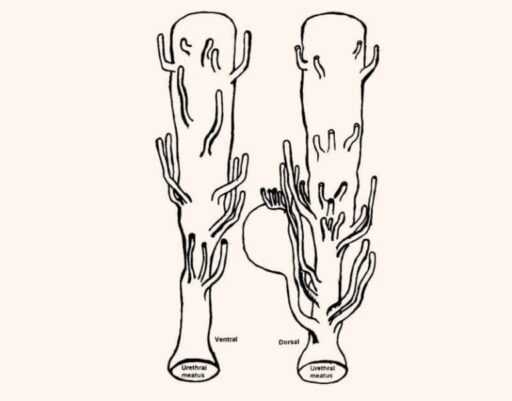
From the book "The Human Female Prostate" by Milan Zaviacic.
Ejaculation Mechanisms During Massage
During a yoni massage, the practitioner uses a variety of movements to wake up the pelvic nerves. These movements send constant signals to the brain, which can trigger the release of a special fluid. This fluid is known as female ejaculate, and it is produced by the prostatic glands. It is a thick, milky liquid that is chemically very similar to the male version.
Because the massage involves many different sensations, a woman often does not notice the fluid moving. The brain is so busy processing the touches that it ignores the subtle feeling of the glands emptying. After the session, the practitioner might see this milky fluid on their disposable glove. This shows that the organ is working perfectly, even if the woman is not consciously aware.
Somatic Integration and Conclusion
Recognizing the female prostate as a functional organ is a major step toward sexual empowerment. It helps women understand that their bodies are designed for multiple types of pleasure and release. This knowledge helps to remove the shame or confusion that some women feel about their natural fluids. It turns a biological process into a celebrated part of the somatic experience.
Integrating this anatomical knowledge into a yoni massage creates a deeper sense of connection. The woman can visualize her internal glands and understand how they respond to touch. It is a vital part of understanding the mechanisms of pelvic sensitivity and how the body functions. By combining science and somatic practice, we create a path for total body awareness. The female prostate is a vital part of the journey toward a more vibrant life.