

Understanding female anatomy requires moving beyond surface-level observations toward a more integrated view of internal structures. The CUV complex—which stands for Clitourethrovaginal—is a unified functional network that explains how different parts of the pelvic anatomy interact during stimulation. This perspective shifts the focus from isolated “spots” to a holistic map of sensitivity, providing a clearer view of the internal anatomy of pleasure. In a yoni massage, recognizing this complex allows for a deeper appreciation of how internal sensations are interconnected, creating a more resonant and safe experience for the recipient.
From the G-Spot to the CUV Concept
For decades, the search for a singular, anatomical “G-spot” dominated scientific discussion, yet modern research has shifted this focus. Early XXI-century imaging studies, particularly the use of dynamic ultrasound, revealed that what was once sought as a localized spot is actually a broader functional area. Researchers found that during vaginal penetration, the anterior vaginal wall moves in a way that increases contact with the surrounding structures. This discovery led to the emergence of the clitourethrovaginal complex as a term that harmonizes the roles of the vaginal wall, urethra, and clitoris. Instead of a hidden button, science now recognizes a merging of tissues where individualizing these organs becomes difficult, forming a unified erogenous zone (G-spot: Fact or Fiction?: A Systematic Review).
Beyond the Visible: The Internal Clitoris
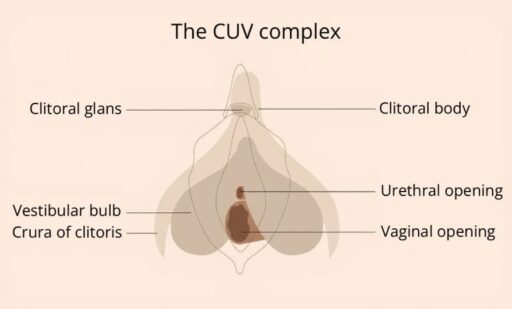
The clitoris is much more than the visible glans; it is a large, wishbone-shaped organ that extends deep into the body. Most of its structure consists of the bulbs and crura, which wrap around the vaginal canal and urethra. When we speak of a clitoral diagram, we must include these internal arms that engorge with blood during arousal. This internal presence is what creates the foundation for deep sensitivity, as the roots of the clitoris are directly influenced by pressure and movement within the pelvic floor.
The Role of the Urethra in the Complex
The urethra is not just a tube for fluid; it is surrounded by erectile tissue and sensitive nerves that are part of the broader CUV network. During arousal, the tissues surrounding the urethra become part of the shared vascular response of the entire complex. This proximity explains why stimulation in one area often echoes through the others. Understanding this connection helps practitioners navigate the pelvic area with more precision, acknowledging that the urethra is a vital component of the body’s pleasurable response system.
The Vaginal Wall as a Sensory Interface
The vaginal canal serves as the interface where the different elements of the CUV complex meet. The anterior wall of the vagina is particularly sensitive because it lies in close contact with the internal structures of the clitoris and the urethral sponge. This area is often where the integrated response of the complex is most felt. By viewing the vagina not as an isolated canal but as a part of a larger sensory map, we can better understand the internal anatomy of pleasure and how internal touch activates a wide range of nervous system responses.
Mapping the Unified Response
The term “CUV complex” was coined to describe how these three structures—the clitoris, urethra, and vagina—work together as a single functional unit. They share a common blood supply and a dense network of nerves. When one part is stimulated, the entire complex responds. For instance, safely engaging the delicate tissue of the urethral spot naturally activates the surrounding clitoral network without deep internal pressure. This unified reaction is why sensations often feel diffuse and deep rather than localized. Acknowledging this unity is essential for anyone learning about pelvic health or somatic bodywork, as it explains the biological reality of female pleasure.
How the CUV Complex Influences Arousal
Arousal is a systemic process that involves the gradual engorgement of the entire CUV complex. As blood flow increases, the tissues expand and become more responsive to touch. This physiological shift changes the way sensations are perceived by the brain. If the pace of a session is too fast, the complex may not have enough time to fully engorge, which can limit the depth of the experience. Moving slowly allows the vascular and nervous systems to align, leading to a more profound and regulated state of arousal.
Nervous System Integration and Safety
The CUV complex is deeply connected to the autonomic nervous system. Because this area is so rich in nerve endings, it is also a place where the body may store protective patterns. Ensuring a state of safety is paramount when working with such sensitive anatomy. When the nervous system perceives a threat, the tissues of the CUV complex may tighten, reducing sensitivity. Somatic education focuses on creating an environment where the body feels safe enough to allow these internal structures to relax and respond.
The Impact of Physical Diversity
Just as faces differ, every CUV complex is unique in its exact shape, size, and sensitivity. Some women may have more prominent urethral sponges, while others may have clitoral bulbs that sit closer to the vaginal wall. This biological diversity means that there is no “one size fits all” approach to touch. A clit diagram should be seen as a general guide rather than a rigid blueprint. Respecting individual anatomy is a core principle of ethical bodywork and self-exploration.
Pacing and the Internal Map
The internal map of the CUV complex is best explored through a slow and attentive rhythm. Rapid movements can skip over the subtle layers of sensation that these deep structures provide. By slowing down, the recipient can begin to distinguish between different types of internal signals. This practice of moving toward a deeper energetic connection with patience ensures that the complex is not overwhelmed but invited into a state of curious and open awareness.
Conclusion
The CUV complex represents the biological truth of an integrated pelvic response. By mapping the connections between the clitoris, urethra, and vagina, we move toward a more accurate and respectful understanding of the internal anatomy of pleasure. This knowledge empowers individuals to communicate their needs and boundaries more clearly. In the context of somatic education, the CUV complex is not just an anatomical fact—it is a gateway to deeper self-awareness and a more profound connection to one’s own internal landscape. For those who wish to explore these principles in practice, our yoni massage classes offers a safe and structured environment to deepen your somatic experience.