
The secret of a truly good yoni massage is not found in hand technique alone. Many practitioners focus on pressure, rhythm, and position — and all of that matters.
But something deeper shapes the quality of every session: the state of energy inside the practitioner’s own body.
When that inner state is awake and moving, the touch carries something that no technique can replicate on its own. Mula bandha is the practice that makes this possible, and it runs quietly beneath every movement of the hands.
Why the Practitioner's Inner State Matters
A yoni massage session is not a one-directional event. The woman receiving the massage responds not only to physical touch but to the presence and intention behind it.
A practitioner who is distracted or energetically flat transmits that quality through their hands, whether they intend to or not.
One who is grounded, present, and actively working with their own energy creates a very different kind of contact. Hands become a channel, and what flows through that channel depends entirely on what the practitioner is doing inside their own body the whole time.
The Moment You Needed a Toilet — and There Was None
Most people know this feeling well. You are far from a bathroom, the urge to urinate grows strong, and your body responds on its own without any instruction. Something tightens deep in the pelvis.
Pelvic floor muscles engage and lift. A contraction around the bladder sphincter holds everything in place. Your body locks down fast and efficiently to stop the flow.
Those are exactly the muscles used in mula bandha — and now you know how to find them. (This is simple version of mula bandha).
Which Muscles Contract in Mula Bandha
Mula bandha targets the pelvic floor — the group of muscles that form the base of the torso. These muscles wrap around the urethra, the vaginal canal, and the rectum.
When they contract as a unit, a clear lifting sensation appears deep in the lower body. For a practitioner of yoni massage, learning to feel this group as one coherent structure is the first real step.
Contraction does not come from the outside or from the skin. It rises from deep within and moves upward through the core of the body.
The Inhale — Engaging the Pelvic Floor at 50%
At the start of each breath cycle, the practitioner draws air in slowly and with full awareness. On the inhale, the pelvic floor muscles contract to roughly half of their maximum possible tension — firm but not locked, engaged but not strained.
This level matters. Full tension creates rigidity and blocks the flow of energy. Loose engagement produces no effect at all. At fifty percent, the body finds a working balance between activation and ease.
That balance is the entry point of the practice and sets everything else in motion from there.
Moving Energy Up the Spine to the Heart
Once the pelvic floor engages on the inhale, attention shifts upward along the spine. Energy gathers in the pelvic basin — warm, alive, and ready to rise.
From the pelvis to the head, the body carries three main energetic channels running through the torso: a left channel, a right channel, and a central one that follows the line of the spine directly.
The practitioner directs energy into that central channel with intention and imagination — not forcing it, but guiding it steadily upward with each breath. Physical contraction creates real sensation, and the mind can follow it naturally.
Practitioners who already work with prana and the breath-body connection as a living current in bodywork will find this movement easy to deepen.
The Golden Sphere — Holding Energy at the Heart Center
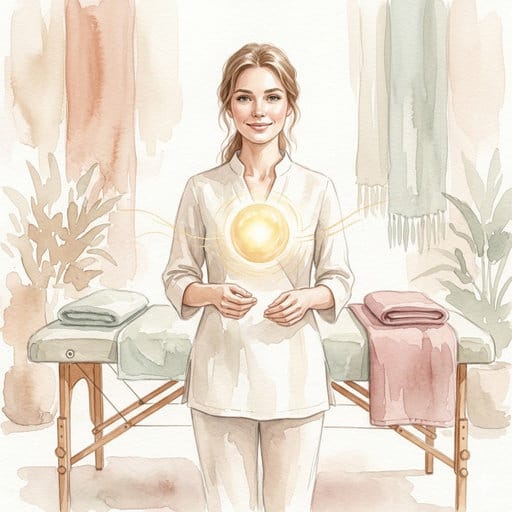
As energy reaches the chest, the practitioner holds a clear image at the level of the heart — a sphere of warm golden light. This sphere receives what has been lifted from below. On the inhale, it fills.
The image does not need to be sharp or vivid. What counts is that awareness stays at the heart center while the pelvic floor holds its gentle contraction.
Energy does not scatter or rise past the chest. It gathers, warms, and waits for the exhale.
The Exhale — Releasing Energy Through the Hands
On the exhale, two things happen at once. Pelvic floor muscles soften and release their contraction fully. At the same moment, energy held in the heart center flows outward — down through the arms and into the palms.
No pushing or forcing is needed. Releasing the breath and relaxing the pelvic floor is enough to start the flow. Hands already resting on the body of the woman receiving the session become the endpoint of this current.
Outwardly, the touch does not change. But something in its quality shifts in a way that both people in the room can feel.
Joe Dispenza and the Science Behind the Practice
From a scientific point of view, this process has a clear explanation. Contracting the muscles of the pelvic floor creates upward pressure on the cerebrospinal fluid — the liquid that surrounds the brain and spinal cord.
As this fluid moves upward through the spinal canal, it produces a piezoelectric effect in the tissues of the brain. That effect stimulates the pineal gland — a small structure deep in the brain linked to altered states and inner coherence.
Ancient traditions called this energy rising through the spine. Modern neuroscience calls it fluid mechanics and electrical activation. Both point to the same result: a practitioner who is more present, more awake, and more connected to the work their hands are doing.
Practicing Mula Bandha Throughout the Entire Massage
This rhythm runs through the whole session — not just at the start as a warm-up. Each inhale brings a gentle pelvic floor engagement. On every exhale, energy releases and flows outward through the hands.
Over time, the cycle grows quiet and natural. It runs in the background beneath every stroke and every pause. Nothing in the visible touch changes. But the session becomes something different — not just a physical procedure, but a live exchange of energy from one body to another.
Practitioners who want to develop this capacity with full guidance on breath, energy, and somatic awareness can find a structured path inside the online yoni massage course.