

Understanding the history of female pleasure allows us to leave harmful myths behind.
For many years, medical professionals remained silent about the fluids released during a peak of joy. Most experts assumed any such release was a sign of a weak bladder, which caused women to feel deep shame about their natural bodies.
However, things changed significantly in the early 1980s when researchers used lab tests to find the biological truth. By looking at the chemical facts, they opened a new door for somatic education and body trust. Today, we use this groundbreaking work to support students in their own paths of somatic joy.
The 1981 Scientific Breakthrough
In 1981, six dedicated experts published a report that changed sexology forever. The paper was titled “Female Ejaculation: A Case Study” and it appeared in a major journal – The Journal of Sex Research.
Led by Frank Addiego, the team wanted to prove that female ejaculation was a legitimate physiological event. They worked with a woman who reported large releases of fluid during her intense orgasms.
Before this work, many people assumed these fluids were only urine caused by poor bladder control. The 1981 team decided to test actual samples to find the chemical reality. Their findings showed that these expulsions were a unique response rather than a medical defect. This study allowed women to start trusting their own bodies again.
Structure of the Original Case Study
The 1981 paper is organized into seven distinct sections that outline the journey of the researchers:
- It begins with an untitled introduction where the authors explain their goal to explore female ejaculation.
- The second section, “Background Information About the Subject,” describes the history of the woman selected for the study.
- In “The Grafenberg Spot,” the researchers identify the sensitive zone they chose to name.
- The next part, “Orgasmic Expulsion by the Subject,” details how the releases occurred during stimulation.
- This is followed by “Collection and Analysis of Orgasmic Expulsion,” which explains the chemical procedures.
- In “Comparison of Orgasmic Expulsion and Urine,” they present their comparative data.
- Finally, the “Discussion” explains why their work disproves old ideas about bladder control and supports a healthier view of the body.
Methodology of the Landmark Case Study
The team in 1981 followed a clear and rigorous plan to gather their facts. They focused on one woman to observe how her body reacted in a controlled lab setting.
The team watched the subject while her husband stimulated the firm area on the front wall of her vagina. They used bright lights to confirm exactly where the fluid came from during the climax.
They confirmed that the liquid was exiting through the urethra and not from the vaginal opening. This was a vital point because it proved that the female urethra can carry more than just urine. This mirrors the nature of the male anatomy and was a big change in our somatic knowledge.
Chemical Evidence Against Incontinence
The main part of the 1981 study was a chemical test that stopped the idea of bedwetting. The team took samples of orgasmic fluid and urine from the same woman for comparison. They looked for a special protein found in the male prostate gland.
They discovered high levels of this protein in the orgasmic fluid but not in the urine samples. At the same time, the levels of urea were much higher in the urine.
This chemical proof showed that the two liquids were not the same substance. This fact showed that their expulsions were a sign of somatic health.
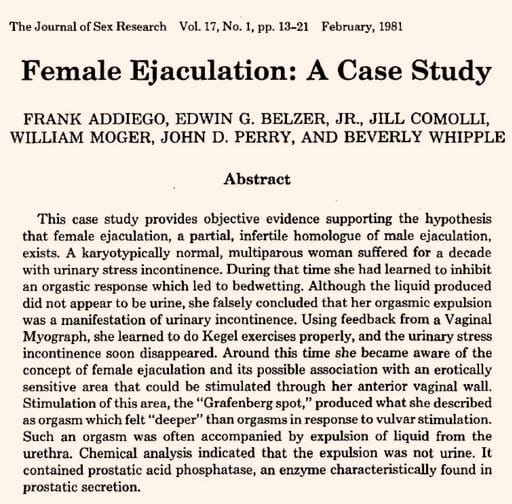
scribd.com
Tribute to Dr Ernst Grafenberg
For those who study yoni massage, this 1981 paper is very special.
It marks the first time in modern science that the term Gräfenberg spot was officially used. The authors chose this name to pay a formal tribute to Dr. Ernst Gräfenberg, a gynecologist who described this sensitive area many years before. During his lifetime, his work was largely ignored because of prevailing social taboos.
Addiego and his team brought his original research back to the world and gave it a place in modern science. They identified the spot as a firm zone on the anterior vaginal wall that responds to deep pressure. This area is now recognized as a primary gateway to somatic release.
The 1981 Publication vs the 1982 Book
Many people believe the G-spot became famous only through a book published in 1982. This book was called “The G Spot and Other Recent Discoveries About Human Sexuality” and it was a massive success.
However, the scientific foundation was actually laid one year before. The 1981 case study provided the rigorous data that the book used to support its claims.
This timeline is vital for anyone studying somatic history because it shows that clear proof came first to break the silence. By knowing this, we can value the careful research that was done in the early eighties.
Social Impact and the End of Shame
The 1981 report had a massive impact on how society viewed female sexuality. Before this data, many women were told they had a physical problem or a defect. They were treated for bladder issues that did not exist, which led to years of silence and fear.
The woman in the 1981 study had even learned to stop her own joy because she was so ashamed.
However, when the experts showed her the lab facts, she felt free for the first time. She was able to enjoy her body and her orgasms without the burden of shame. This shift in perspective is the foundation of somatic healing.
The Evolution of Modern Fluid Science
In 1981, the team did not yet distinguish between two different fluids. At that moment, they called everything female ejaculation. But this paper started decades of new research.
Later studies, like the report titled “New insights from one case of female ejaculation”, showed a wider and more complex picture.
We now know that the body can have two separate somatic events. One is female ejaculation, which is a small amount of thick fluid. The other is squirting, which is a large amount of thin fluid. Both are normal and safe, involving different parts of the pelvic floor and tissues.
Practical Learning for Yoni Massage
Today, we take the facts from 1981 to help our students grow. We value the history of the G-spot and the work of pioneers like Frank Addiego. We also use the latest findings about fluids and the human arousal cycle. All of these steps are vital for a professional session.
The ways to find the needed spot and activate the female ejaculate composition and somatic secrets are taught with care. These techniques are shown step by step in an yoni massage online course. This allows students to learn at their own pace and build trust. This is a path of healing for every woman who wants to learn.