

For many decades, medical books relied on studies of animals to describe human anatomy. Scientists often looked at livestock to guess how the human body works. However, humans are unique, especially when it comes to the nervous system.
Recently, a major study from Oregon Health & Science University changed everything. This research provided a precise count of the nerves in the human clitoris for the first time.
For those who study or practice yoni massage, this research is very important. It offers a scientific reason why certain types of touch lead to deep shifts in the mind and body.
The Landmark Discovery and Modern Microsurgery
Recent surgical research (news.ohsu.edu) has finally confirmed a stunning fact: the human clitoris contains a massive network of individual nerve fibers.
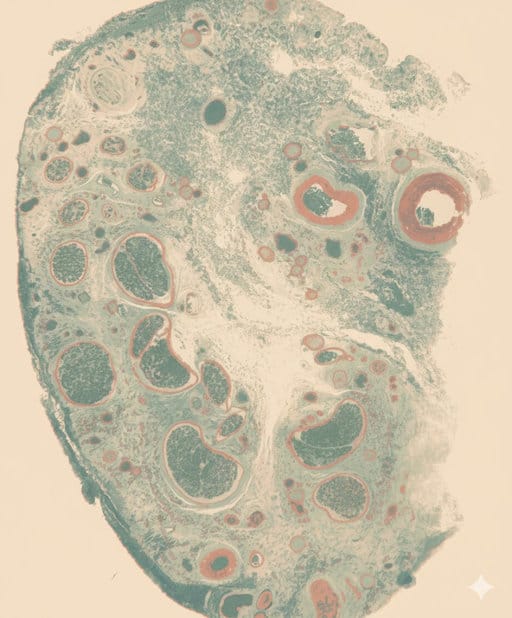
For a long time, books said there were about 8,000 fibers. This new study shows the number is much higher. Researchers analyzed small samples of nerve tissue magnified 1,000 times under powerful microscopes. Individual nerve fibers, known as axons, are so small they cannot be seen by the human eye alone.
Using specialized image analysis software, the team counted every single axon within the dorsal nerve—the main path for clitoral sensation.
Small Size, Massive Neural Density
The density of nerves in the clitoris is truly staggering. To understand this, we can compare it to other parts of the body.
Think about the median nerve in your wrist, which is involved in carpal tunnel syndrome. The median nerve has about 18,000 fibers. However, the hand is many times larger than the clitoris.
Having over 10,000 fibers packed into such a tiny space makes the clitoris a “super-center” of sensitivity. This high density explains why even the lightest touch can feel so intense.
The Symmetry of the Dorsal Nerve
The research focused on the dorsal nerves, which are symmetrical tube-like structures shaped like a wishbone.
Scientists counted an average of 5,140 fibers on just one side. Because the body is symmetrical, they multiplied this by two. This gave a total estimate of 10,281 nerve fibers.
But the story does not end there. The clitoris also has other, smaller nerves that were not part of this specific count. This means the actual total number of nerves is likely much higher than 10,000.
Closing the Historical Knowledge Gap
In the past, medical science did not spend much time studying the vulva. Most anatomical research focused on male bodies. This led to a huge gap in our knowledge of sexual health.
Even when early pioneers attempted to gather data, such as during a massive anatomical measurement study focused on the female pelvis, they often relied on flawed patriarchal theories rather than mapping actual nerve density.
Now, researchers are finally giving this organ the attention it deserves. By gathering hard data, we can move away from these old myths and dangerous guesses. This information helps us understand how the body heals and how it feels. It is a vital step toward a more inclusive medical world.
A Rising Tide for Sexual Health
The lead researcher, Dr. Blair Peters, noted that this study was only possible because of transgender volunteers who underwent gender-affirming surgery.
When we improve healthcare for one group, we gain knowledge that helps everyone. Advances in gender-affirming care provide the data we need to help all people.
This research is a “rising tide” that lifts all boats. It improves our understanding of surgery, healing, and pleasure for everyone, regardless of their gender identity.
Integration of the Whole Nervous System
Knowing that you have over 10,000 nerve fibers in a single organ changes how you view yourself. It is a reminder of your biological potential for joy.
However, true somatic healing comes from moving beyond a single point. Yoni massage is about the “whole.” It is about how the breath, the skin, and the brain all work together.
We use the clitoris as a starting point, but we aim for full-body integration. This holistic approach ensures that the experience becomes a process of deep neural and somatic reorganization that leads to presence and self-love.
Accessibility and Self-Discovery
Technically, the clitoris is a primary erogenous zone because it is easy to reach. The glans is located outside the body, making it very accessible.
This allows for a direct and fast link between touch and the brain. This ease of access is very helpful for learning.
It helps a woman understand her own boundaries. It teaches the brain what safe and consensual touch feels like. In a somatic sense, it is the perfect training ground for the nervous system to learn how to process pleasure.
The Only Organ Dedicated to Pleasure
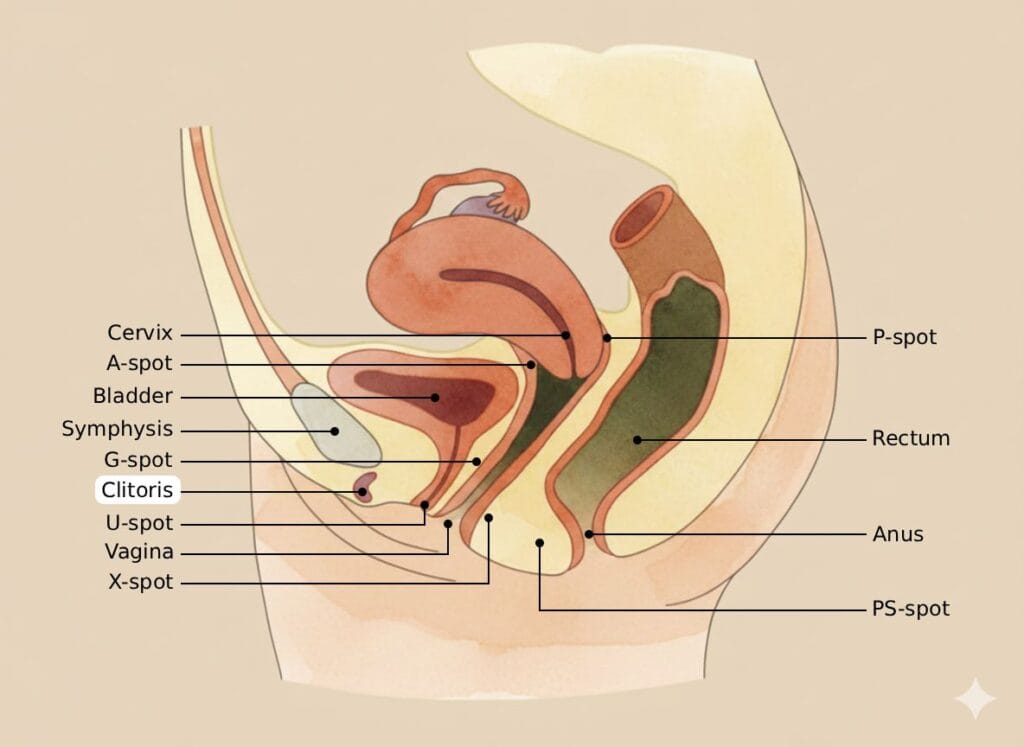
The clitoris is the only known human organ with the singular purpose of providing pleasure. While the tip is outside, much of the clitoris is located internally.
Because clitoral arousal is often simple and fast, some yoni massage practitioners focus mainly on this spot.
However, this is a narrow view. While the clitoris is a powerful “button,” it is part of a much larger system. It should be seen as a gateway to the entire body’s sensitivity, not the final destination.
Balancing Local vs. Global Arousal
A skilled practitioner must understand the balance between local and global arousal. The clitoris is so sensitive that it is easy to get “stuck” there. If a session focuses exclusively on this one spot, the recipient may have a fast, local release.
To work effectively with the clitourethrovaginal (CUV) complex as a scientific model, the practitioner aims to involve the whole nervous system.
This means moving energy away from just one point and spreading it through the entire body. It is essential to give attention to all erogenous zones to create a full experience.
The Role of the Practitioner
A yoni massage practitioner acts as a guide for this neural network. Because the clitoris has over 10,000 fibers, the touch must be very mindful. If the touch is too fast, it can overwhelm the nerves.
The practitioner uses the knowledge of neural density to find the right rhythm. They help the client move from a state of stress to a state of deep relaxation.
This turns a physical act into a profound somatic education. Every new discovery helps us create a safer and more empowering space for somatic exploration.