

Understanding biological rhythms is a vital skill for any somatic practitioner. The human body does not experience pleasure in a random way. Instead, it follows a specific sequence of physical and neural changes. By learning the sexual response cycle, you can turn a simple session into a deep journey of discovery. This model acts as a roadmap for the nervous system during a yoni massage. It helps the practitioner stay in tune with the body’s natural timing. When you respect these phases, you create a space where deep sensitivity can grow without pressure or rush.
The Pioneers of Human Sexuality: Masters and Johnson
William Masters and Virginia Johnson were the first scientists to look closely at what happens to the body during intimacy. In the 1960s, they moved away from old myths and focused on hard data. They used medical tools to track heart rates, muscle tension, and blood flow. Their work was a major breakthrough because it treated pleasure as a healthy biological process. They proved that the body goes through a predictable cycle of changes. This research laid the foundation for modern somatic work and helped us understand how to support the nervous system effectively.
Modern Evolution of Sexual Response Models
Since the time of Masters and Johnson, other experts have added new ideas to the field. For example, Rosemary Basson introduced a circular model that focuses more on emotional intimacy and mental receptivity. While these newer theories are very helpful, the original four-phase model remains the best tool for somatic learning. It provides a clear and linear way to observe physical changes in the body. For anyone learning yoni massage, this classic model offers the most practical guide for tracking arousal and ensuring safety.
Phase One: The Awakening of Excitement
The first stage is about waking up the senses. During the excitement phase, the parasympathetic nervous system becomes active. This causes blood flow to increase in the pelvic area, a process known as vasocongestion. The body begins to soften and prepare for touch. Often, this process starts by activating the powerful neural link between the chest and the pelvis. A key part of this phase is neuroception, which is the brain’s subconscious way of checking for danger. If the person feels safe, the body opens up. If there is stress, the cycle stops. This is why a slow start is essential for building a solid foundation of trust.
Phase Two: The Intensity of the Plateau
In the plateau phase, the initial excitement levels off and becomes more stable. The term comes from the geological formation of a flat-topped mountain with a level surface. In this state, the heart rate stays high, and muscle tension increases slightly. This is not a flat line, but a state of high readiness. The body and brain are now fully engaged in sensory processing. In a yoni massage, this is the time when deep sensitivity is most accessible. The tissues are fully engorged and responsive. It is a powerful stage where the practitioner and the recipient can explore subtle sensations without moving too quickly toward a finish.
Phase Three: The Peak of Orgastic Release
The third phase is the peak of the cycle. It is a brief moment where the built-допомога tension is released. From a neural perspective, the brain processes a massive flood of sensory signals. There is a quick shift toward the sympathetic nervous system as the muscles experience rhythmic contractions. While many people see this as the final goal, in somatic practice, it is simply one way the body finishes a cycle of energy. It is a natural discharge that clears the system and allows for a transition into deep rest.
Phase Four: Resolution and Somatic Integration
The resolution phase is often ignored, but it is one of the most important parts of the experience. This is when the body returns to its normal state. The blood leaves the pelvic area, and the heart rate slows down. In yoni massage, this is a vital time for integration. The recipient needs space to feel the after-effects of the session. Rushing to end the session at this point can disrupt the learning process. Staying present during resolution helps the nervous system “record” the feeling of safety and pleasure.
The Somatic Wave: Sustained Plateau and Sensory Summation
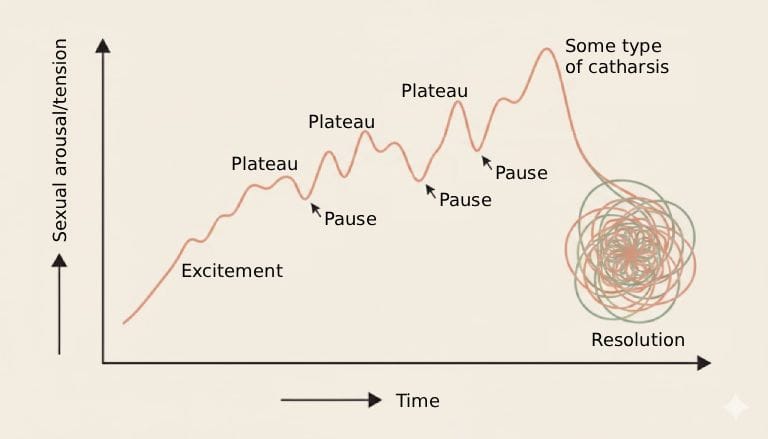
A unique part of advanced somatic work is the use of the “somatic wave.” Rushing toward a climax usually means the refractory period begins and the session ends. Instead, the practitioner keeps the recipient on a long, undulating wave of pleasure. This technique uses temporal summation, where the brain collects sensory signals over time. By stopping just before the point of no return (before orgasm), the practitioner allows the excitement to dip slightly and then rise again. This creates a “staircase effect.” This rhythmic riding of the waves can be sustained for tens of minutes, allowing the sensory experience to expand far beyond ordinary limits. Each new wave of the plateau feels higher and deeper than the one before because it builds on a pre-activated neural foundation.
The Physiology of Catharsis: Beyond Physical Pleasure
Holding a high level of arousal without an immediate genital release often leads to a systemic somatic discharge. This is much deeper than a standard climax. When the brain processes a constant flow of signals from deep pressure receptors, it can bypass the usual pathways. This intense energy helps release stress stored in the pelvic floor as the limbic system processes old tension. This process can trigger a deep emotional catharsis, helping the person let go of old patterns held in the body’s tissues.
Neurogenic Tremors and Recalibration in Yoni Massage
During this deep work, it is common to see physical signs like shaking or vibrating. These are known as neurogenic tremors. They are not signs of fear; they are the nervous system’s way of resetting itself. You might also see tears or hear deep sighs. This is a sign of recalibration. The body is literally discharging old energy and updating its internal map of sensitivity. It is a therapeutic reset that leaves the person feeling lighter and more connected. Understanding the role of the vagus nerve in arousal is essential here, as it helps calm the system after such a big release.
Conclusion: Enhancing Sensitivity Through Education
Mastering the sexual response cycle allows you to move beyond simple techniques. It gives you the power to guide the nervous system through complex layers of feeling and release. By learning how to navigate the waves of the plateau and support the resolution phase, you become a guardian of the recipient’s somatic journey. This level of skill requires both knowledge and practice. If you want to dive deeper into these methods, our yoni massage online course offers detailed lessons on how to apply these biological rhythms in a professional and healing way.