

The body needs touch the way it needs food and water. This is not a metaphor. Skin hunger — also called touch starvation — is the drive for physical human contact.
When that need goes unmet, the nervous system begins to suffer. Touch deprivation affects mood, stress levels, sleep, and even the immune system.
In yoni massage, conscious touch is not a luxury. It is a tool for restoring what the body has been missing.
Harry Harlow and the Comfort-Contact Theory
In the 1960s, psychologist Harry Harlow ran experiments with infant rhesus monkeys.
He separated them from their mothers and gave each monkey two surrogate figures. One was made of wire and provided food. Covered in soft terrycloth but giving nothing to eat, the other was chosen by the monkeys almost every time. They ran to her when frightened and spent hours pressed against her soft surface.
Harlow’s conclusion was clear: the need for comforting touch is more powerful than the drive for food. This finding changed how we understand early attachment and the role of physical contact in healthy growth.
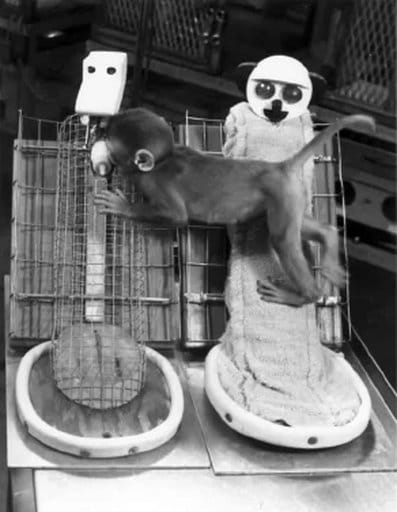
(Courtesy of Harlow Primate Laboratory, University of Wisconsin-Madison)
researchgate.net
The Vagus Nerve and Pressure Receptors
When skin is touched with steady, gentle pressure, receptors beneath the surface send a signal to the brain. Researcher Tiffany Field explains that this signal travels to the vagus nerve — a long cranial nerve that connects the brain to the major organs.
As vagal activity rises, the body shifts into a state of calm. Heart rate drops. Blood pressure falls. Stress hormones like cortisol decrease. The nervous system moves from protection to rest.
This is the same shift that yoni massage aims to create from the very first moment of contact. Touch is not just comfort — it is direct input to the nervous system.
Oxytocin and the Bonding Response
Touch also triggers the release of oxytocin, a hormone linked to trust, bonding, and calm. Research has found a group of neurons in the brain with receptors for oxytocin. When these neurons fire, they rapidly reduce the stress response.
This explains why a single moment of kind physical contact can shift a person’s entire mood. Oxytocin does not just make us feel warm — it actively suppresses the circuits that drive fear.
In somatic practice, building oxytocin through slow, safe touch is one of the core goals. Without it, deeper work is not possible.
What Happens Without Touch
The effects of touch deprivation are well documented.
- Premature babies placed on a parent’s bare chest gain weight faster than those kept in incubators alone.
- Children who receive little physical contact in early life show signs of reactive attachment — a condition where the ability to form safe bonds is disrupted.
- In adults, chronic touch starvation is linked to anxiety, depression, and poor sleep.
- Prisoners in solitary confinement often describe craving human contact with the same force as freedom.
The body keeps a record of how much touch it has received — and how much it has missed.
Cultural Differences in Touch
Attitudes toward physical contact vary widely between cultures.
Some societies treat touch between friends and strangers as common and unremarkable. Others view physical contact outside of close family as rare or even threatening. These norms are absorbed in childhood. The way parents touch each other and their children shapes a person’s sense of what is safe.
In cultures where touch is treated as shameful, skin hunger is often denied rather than addressed. This denial does not make the need disappear. It drives it underground, where it shows up as tension, emotional distance, or chronic pelvic armoring.

Skin as the Oldest Organ
The skin is the largest and oldest organ in the human body. It covers every surface and never stops sensing the world. All other senses — sight, hearing, smell, taste — are in some way extensions of touch. Even the cornea of the eye is covered by a layer of modified skin.
The skin is our first border and our first form of communication. Long before language existed, the body spoke through contact. This is why touch can reach places that words cannot.
In somatic work, we return to this older language. We use the skin to say what cannot be said aloud — and, over time, to rebuild the body’s felt sense of itself from the inside.
Conscious Touch in Somatic Practice
Not all touch is equal. A fast, mechanical touch activates different receptors than a slow, deliberate one.
C-tactile fibers in the skin respond most strongly to gentle, slow stroking at around five centimeters per second. This type of touch directly activates the parasympathetic system and promotes oxytocin release.
Yoni massage uses exactly this quality of contact. The goal is not stimulation for its own sake but restoration of the body’s sense of safety through skin. This is how conscious touch addresses skin hunger — not through speed or intensity but through presence and care.
Research into how deep pressure affects the nervous system explains exactly why slow touch works where fast touch cannot.
Self-Touch and Solo Practice
Skin hunger can also be addressed through self-touch. Massaging the feet, hands, scalp, or arms activates the same pressure receptors as touch from another person.
The effect is smaller but real. For people with limited access to safe physical contact, solo practice offers a meaningful starting point.
Breathing exercises deepen the effect by calming the system and making the body more open.
Solo yoni massage is one of the more advanced forms of this practice — a way to restore connection to parts of the body that have been numb or ignored for a long time.
Building a Touch-Safe Environment
For touch to address skin hunger, it must feel safe. A body under threat will not open to contact, no matter how skilled the practitioner. It must be warm, quiet, and private.
The pace must be slow enough for the nervous system to catch up. Consent must be active and ongoing. The practitioner must bring calm presence rather than a goal or agenda. When these conditions are met, the body begins to receive touch.
This is the foundation of all somatic work. Touch is only medicine when the body is ready to take it. To explore how this applies in practice, visit our yoni massage course for practitioners and partners.