

Self-esteem shapes sexuality not through thought but through the body. A woman with low self-esteem does not just think she is not good enough — her body lives inside that belief every day.
It shows up as tension that never fully releases, breath that never drops into the belly, and a quiet inability to receive without watching herself do it.
In yoni massage, this pattern becomes visible quickly. A body that cannot rest in its own worth cannot fully open to touch, pleasure, or connection.
What Low Self-Esteem Feels Like in the Body
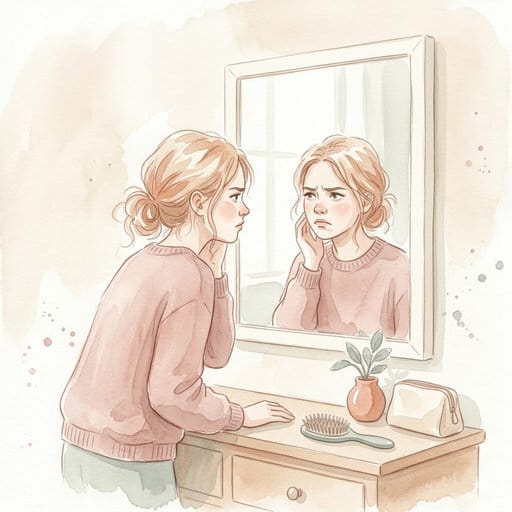
Low self-esteem has a physical signature. Chest slightly closed, jaw holding background tension, breath managed rather than free. The nervous system stays in a low-level state of readiness — not for danger exactly, but for judgment.
This is the body of someone who has learned that being seen is risky. Relaxation feels unsafe because relaxation means dropping the guard.
Dropping the guard means someone might see that you are not enough. Many women carry this state for so long that it no longer feels like tension — it simply feels like themselves.
The Link Between Worth and Permission
To receive pleasure, a person must feel they have a right to it. This is not obvious and it is not automatic. Many women have no conscious objection to pleasure — but the body refuses it anyway.
Giving feels safe. Receiving feels exposed.
A woman who does not feel worthy will find ways to stay busy, to focus on the partner, to redirect attention away from her own experience. She gives constantly and receives with discomfort, because receiving requires believing that you deserve what is being offered.
Performance Over Presence
When self-worth is low, presence is replaced by performance. Instead of feeling, the woman watches herself from a slight distance — monitoring her reactions, checking whether she looks right, wondering if the partner is satisfied.
This split between observer and experiencer is one of the most reliable signs that self-esteem is affecting the session. It is the same gap that somatic awareness and cognitive understanding describe from a neurological angle.
Pleasure cannot move through a body that is busy evaluating itself. It needs a body that has temporarily stopped caring whether it is doing it correctly.
The Origin of the Wound
Low self-esteem in the context of sexuality rarely appears from nowhere. Often it begins at home, in childhood, with the voices of parents.
A girl who hears “you are too sensitive,” “you want too much,” or “stop making things up” learns something specific: her inner experience is a problem. Her needs are excessive, and her feelings are not to be trusted. A few key moments can install a belief that lasts for decades.
Beyond the family, other sources reinforce the wound. Early comparison with peers teaches a girl that her worth is relative and competitive. Critical remarks from partners land on ground that was already prepared. Experiences of rejection become evidence that she was right not to trust herself.
And culture delivers a steady background message about which women are desirable, which bodies are acceptable, and which desires are appropriate. A woman who has absorbed all of this does not need anyone to tell her she is not enough. She tells herself, automatically, before anyone else gets the chance.
How Self-Esteem Affects Orgasm
Orgasm requires a complete release of control. For a woman who does not feel worthy, this release is not safe. Control is the only protection she knows. Letting go means being fully seen — and being fully seen is exactly what she has learned to avoid.
This is why self-esteem and orgasm are so closely linked. Not through thought but through the body’s refusal to surrender. Sessions that focus only on technique miss this entirely.
The question is not what to do — it is whether the woman feels safe enough to stop holding herself together. This is also the core insight behind orgasm through relaxation rather than tension.
Receiving as a Skill
For women with low self-esteem, receiving is genuinely difficult. It is not simply a matter of relaxing. Receiving means allowing someone to attend to you — fully, without you doing anything in return.
This feels wrong, like a debt forming, like exposure without protection. Yoni massage is one of the few contexts where a woman is asked to do nothing except receive. No performance, no reciprocity, no task.
For some women this is the first time in their adult life that this has been the only requirement. Understanding what embodied consent actually means helps both the woman and the practitioner navigate this space with care.
What Shifts in Somatic Practice
The body changes before the belief does. A woman does not need to resolve her self-esteem to benefit from somatic work. What changes first is the accumulated experience in her body — session after session of being touched with care, without evaluation, without agenda.
The body begins to build a different record. Touch that asks nothing. Presence that does not judge. Over time, the old belief has less physical evidence to stand on.
It does not disappear overnight. But it loses its grip, slowly and from the inside out. This process is described in more detail in the work on releasing trauma through yoni massage.
The Practitioner's Role
A practitioner cannot give a woman self-esteem. That work belongs to her. What a practitioner can do is refuse to confirm the wound. No evaluation of her responses, no comments that rank or compare, no impatience that signals she is taking too long.
For a woman whose nervous system has been tuned to expect criticism, sustained neutral presence is genuinely new information. The body notices. It registers the difference even when the mind is still skeptical.
This consistency, over time, is what makes somatic work more than physical — and it is also what begins to rebuild the woman’s felt sense of her own body.
From Performing to Inhabiting
There is a moment — not always fast, not always dramatic — when the performance stops. The woman stops watching herself and simply feels. Breath drops, shoulders release, and the body stops managing its own experience and starts having it.
This is arrival. Not a technique, not a result that was aimed for, but a natural consequence of enough safety, enough time, and enough consistent care. This is what becomes possible when self-esteem is not the starting point but the destination — reached through the body, one session at a time.
To explore the full approach to this work, visit our yoni massage course for practitioners and partners.