

The way our body reacts to touch is not a mystery. It is controlled by the nervous system. For many years, people thought the nervous system only had two states: “fight or flight” or “rest and digest.” However, modern science shows it is much more complex. This new understanding helps us see why safety is the most important part of any intimate practice. When the body feels truly safe, it can experience a type of relaxation that goes beyond just physical comfort. This is the foundation of a conscious approach to the body.
Who is Stephen Porges?
The man behind this discovery is Dr. Stephen Porges. He is a famous professor of psychiatry who introduced the Polyvagal Theory in 1994. Before his work, we did not fully understand how the vagus nerve functions. Porges showed that this nerve has different branches that respond to the world in different ways. His research changed how we look at trauma, stress, and human connection. He proved that our heart and face are connected to our nervous system. This connection helps us signal safety to others through our voice and expressions.
The Three Levels of the Nervous System
According to this theory, the nervous system has three main levels. The first level is the most ancient and causes the body to “shut down” or freeze when it feels extreme danger. The second level is the “fight or flight” response, which uses a lot of energy to deal with stress. The third and highest level is the “social engagement” system. This is the state where we feel calm, connected, and safe. In this top level, the body is open to learning and pleasure because it does not feel the need to defend itself.
The Role of the Vagus Nerve
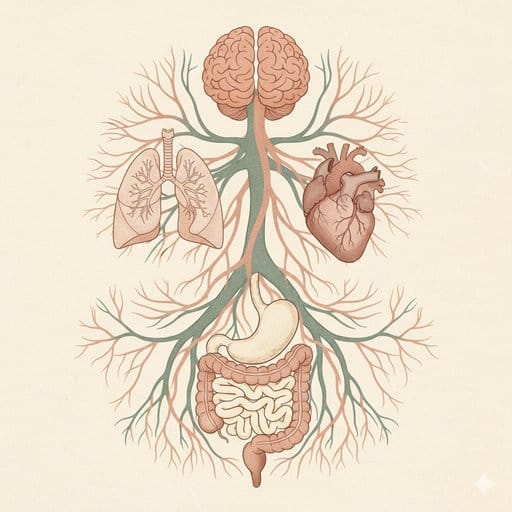
The vagus nerve is the longest nerve in the body. It starts at the brain and travels down to the heart, lungs, and stomach. It acts like a two-way street, sending signals between the brain and the organs. In the context of yoni massage, the vagus nerve is the bridge to relaxation. There is a specific part of this nerve called the ventral vagal branch. When this branch is active, it slows down the heart and relaxes the muscles. This creates the “internal switch” that allows a person to move from stress to deep peace.
Neuroception: The Body’s Internal Radar
Our body is always scanning the room for danger. Dr. Porges calls this “neuroception.” It happens below our conscious thought. Your nervous system listens to the sound of a voice, the speed of a hand, and the tension in the air. If it detects a “cue of safety,” it relaxes the body. If it detects a “cue of threat,” it tightens the muscles. This is why a slow and respectful approach is vital. It tells the nervous system that there is no need to be on guard, allowing deep sensitivity to emerge.
The Ventral Vagal State and Intimacy
When we are in a “ventral vagal” state, our body is optimized for intimacy. This is the only state where the body can truly enjoy soft touch without feeling overwhelmed. In this state, the blood flows easily, and the breath is deep and natural. It is not just about a physical technique; it is about the state of the nervous system. By staying in this zone of safety, a person can experience a profound sense of presence and emotional warmth that is often missing in faster, more goal-oriented practices.
How Trauma Lives in the Tissues
The body remembers everything, even when the mind forgets. Past stress or difficult experiences can get “stuck” in the physical tissues as chronic tension. The Polyvagal Theory explains that this tension is a protective wall built by the nervous system. We do not try to break this wall down with force. Instead, we use the science of safety to show the nervous system that the danger is over. As the body begins to trust the environment, these old patterns of tension can finally begin to melt away naturally.
Pacing and Vocalization in Practice
Small details can have a big impact on the vagus nerve. For example, the speed of movement is a signal. Moving very slowly is a powerful cue of safety. Also, the way we breathe or make sound can help regulate the system. Long, slow exhales or soft humming can stimulate the vagus nerve and deepen the state of relaxation. These simple tools give the learner control over their own internal state. They turn the practice into a conversation between the hand and the nervous system.
Co-regulation Between Partners
Humans are social creatures, and our nervous systems talk to each other. This is called co-regulation. If one person is calm and grounded, their nervous system sends “safety signals” to the other person. This helps the partner relax even more deeply. In a learning environment, the presence of a steady and mindful teacher or partner acts like an anchor. It creates a shared space of peace where both people can explore sensitivity without any pressure or hidden goals.
Conclusion
Understanding the science of your nerves changes how you view your body. It moves the focus from “doing” to “being.” When you respect the biological need for safety, the results are much more profound and lasting. This knowledge is the key to unlocking the full potential of your vitality and pleasure. To learn how to apply these scientific principles at your own pace, you can explore the educational yoni massage course which provides step-by-step guidance for a safe and transformative experience.