

In the 1950s, talking openly about sex was hard. Studying it in a lab was almost unthinkable.
William Masters and Virginia Johnson did it anyway. They brought cameras, sensors, and careful tools into a space that science had always avoided.
What they found changed how the world understands the female body — and built a base that somatic workers, including those who practice yoni massage, still use today.
Who Were Masters and Johnson
William Masters was a doctor who worked at Washington University in St. Louis. He began studying human sexual response in 1954, working alone at first.
Virginia Johnson joined him in 1957 as a research helper. She had no medical degree, but her skill with people and her sharp mind made her key to the work.
Together they formed one of the most useful research teams in the history of sex science. They later married, though the marriage ended in divorce. Their work together, however, produced results that neither could have reached alone.
Observing What Others Only Theorized
Before Masters and Johnson, most knowledge about sex came from talks and theory.
Kinsey had mapped behavior through surveys. Freud had built models from clinical sessions. Nobody had measured what the body actually does during arousal and orgasm.
Masters and Johnson changed that. They brought in hundreds of adult volunteers and recorded what happened in the body in real time — heart rate, blood pressure, muscle tension, and genital blood flow. Their method was bold. It was also more precise than anything done before.
The Four Phases of Sexual Response
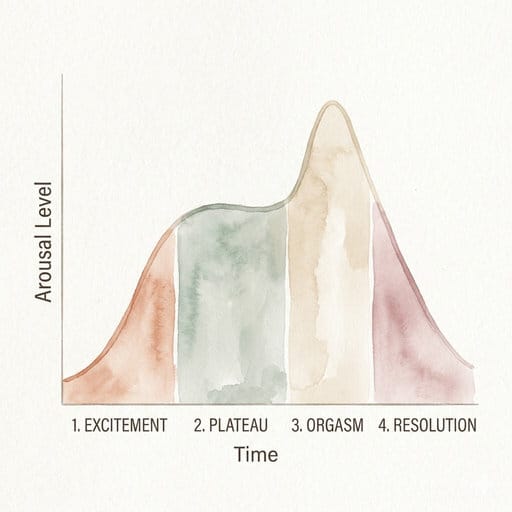
From their data, Masters and Johnson described four phases of sexual response.
- First comes excitement — blood flows into genital tissue, lubrication starts, and muscle tension begins to build.
- Next is plateau — arousal grows deeper and holds at a high level. This phase can last a long time. Plateau is not a pause before something better. This is a state of its own — full, rich, and worth staying in.
- Then orgasm arrives — a peak of muscle contraction and release.
- Finally, resolution brings the body back to its resting state.
This model gave science a clear and repeatable way to study sexual response. It became the base of sex research and therapy for many decades after.
Vasocongestion and Myotonia
Two physical processes run through every phase of sexual response.
The first is vasocongestion — the filling of tissues with blood. It causes erection, swelling, and lubrication in the genitals, and firmness in the clitoris and urethral sponge.
The second is myotonia — a rise in muscle tension across the whole body. This tension builds not only in the genitals but also in the face, belly, thighs, and pelvic floor.
Both happen on their own. They cannot be forced or rushed. For them to work, the nervous system needs to feel safe enough to let arousal move forward without being blocked. This connects directly to how somatic bodywork approaches the body.
Debunking the Vaginal Orgasm Myth
One of the most important things Masters and Johnson found was about the clitoris.
Freud had said that mature women should move from clitoral to vaginal orgasm. This idea shaped medical thinking for decades. It made many women feel broken when vaginal touch alone did not produce orgasm.
Masters and Johnson showed through direct measurement that all female orgasms involve the clitoris — no matter how they are triggered. Vaginal touch leads to orgasm only when it reaches clitoral tissue beneath the surface. This gave the clitoris its proper place as the main structure of female sexual response.
The Book That Changed Everything
In 1966, Masters and Johnson published their findings in a book called Human Sexual Response. It sold widely and reached far beyond academic circles. For the first time, the body’s sexual response was laid out in clear, measurable terms.
The book broke myths that had caused real harm — about female frigidity, about clitoral pleasure being less valid, about what a normal response looks like.
It gave doctors and teachers a solid base to talk about sex without shame. Few books in the history of medicine changed public thinking so fast.

Criticism and Controversy
Masters and Johnson were not free from criticism.
Some felt that lab conditions could not reflect real-life sexual experience. Others raised questions about how they found their volunteers and how they ran some of their studies. Their later work on changing sexual orientation — which they rejected in the end — is a real mark against their legacy.
These concerns are fair and deserve honest attention. They do not erase the value of their core research on how the body works, but they make a full picture of their work more complex than simple praise allows.
Their Legacy in Somatic Science
The impact of Masters and Johnson on somatic science is hard to overstate. The four-phase model, the work on vasocongestion and myotonia, and the insistence on direct observation shaped every field that followed.
This research belongs to the broader lineage of pioneers who brought honest scientific attention to the female body at a time when that attention was seen as unnecessary or wrong.
Without their work, the somatic understanding of arousal, pelvic response, and the nervous system’s role in pleasure would be much thinner than it is now.
Why Their Findings Still Matter for Yoni Massage Today
The four phases of sexual response are not just academic knowledge for a yoni massage practitioner. They are practical tools. Knowing that plateau is a phase of deep, stable arousal — not simply a pause before orgasm — explains why skilled somatic work deliberately extends it.
The body does not need to rush. It needs time and space. Riding the waves of arousal, letting it rise and soften, rise and soften again, builds a depth of experience that a single peak cannot match.
Masters and Johnson gave this process a scientific name and a clear structure. Somatic practitioners gave it a method. Together, they point to what happens when the body is given enough time and safety to fully open.