

Most researchers who study female sexuality focus on what goes wrong. H. Ümit Sayin took a different path. He spent over two decades studying what becomes possible — the outer limits of female pleasure, and the ancient traditions that knew this territory long before Western science arrived.
His work introduced Expanded Sexual Response, or ESR, into the scientific literature. It remains one of the most ambitious attempts to explain female orgasm as something learnable and expandable.
A Researcher Shaped by Two Worlds
H. Ümit Sayin received his M.D. in 1987 in Turkey. He earned a Pharmacology degree, then completed postdoctoral work in neuroscience in the USA between 1994 and 1996.
His career took him through universities in Canada, the UK, and the Netherlands before he returned to Istanbul. Since 2004, he has worked as an associate professor at Istanbul University.
Nearly 17 books, over 50 scientific papers, and around 1200 cited works mark his output. Since 1991, he also wrote over 70 articles in women’s magazines, bringing science to a general audience.
What Is Expanded Sexual Response
ESR describes a series of orgasms that is longer, more intense, and more sustained than a typical single climax. Sayin separated ESR from conditions like persistent genital arousal disorder, which is involuntary and distressing.
ESR, in his view, is learned. It grows through practice, body awareness, and time. In surveys of nearly 2500 women over 25 years, he estimated that ESR exists in about 10 to 15 percent of women.
A deeper state he called status orgasmus — continuous orgasms lasting from 1 to 15 minutes or more — appears in less than 1 percent.
Status Orgasmus and the Orgasmic Train
Masters and Johnson first recorded status orgasmus in 1966, lasting 43 seconds. Sayin extended this picture.
ESR women described orgasmic states lasting from a few minutes to several hours, with 20 to 50 peaks in a continuous train. Each was stronger than the last — this pattern is explored in depth in the article on orgasm through relaxation rather than tension.
Many ESR women reported altered states. Time felt distorted, body boundaries dissolved, some saw visual effects. Sayin listed 85 distinct states of mind that appeared during prolonged ESR orgasms.
Long yoni massage sessions engage the same nerve pathways — which is why deep somatic work can feel so different from a quick touch.
The Four Nerve and Six Pathway Theory
Sayin’s most original contribution is “the Four Nerve and Six Pathway Theory of Female Orgasm”.
Standard models treated female orgasm as 1 thing, triggered by 1 nerve. Sayin proposed that at least 4 distinct nerves carry sensory input to the brain. Each nerve serves different structures and produces a different orgasmic experience.
- Clitoral orgasm travels through the pudendal nerve — sharp and localized.
- G-spot orgasm travels through the pelvic nerve — more diffuse and full-body.
- Cervical input travels through the hypogastric nerve.
- A 4th pathway runs through the vagus nerve, which bypasses the spinal cord — women with complete spinal cord injury can still orgasm this way.
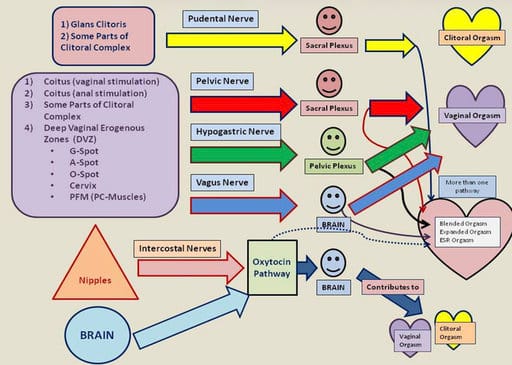
From article "Doors of Female Orgasmic Consciousness".
The Mathematics of Sixty-Three Orgasms
From this model, Sayin drew a clean mathematical conclusion. If 6 orgasmic reflex pathways exist, the number of ways they can combine is 2 to the power of 6, minus 1 — which equals 63.
There are mathematically 63 possible types of female orgasm.
Of these, 57 involve more than 1 pathway at once — what Sayin calls blended orgasms. Female orgasms vary so much between women for exactly this reason. Each pathway responds to a different structure and a different kind of touch.
Tantra, Taoism, and the Ancient Precedent
Sayin argues that modern science is catching up to what ancient cultures already practiced. In Tantric and Taoist traditions, prolonged sexual activity and extended female orgasm were not rare — they were the goal.
Taoist texts from the first century B.C. describe methods for sustaining female pleasure over long periods. Men were taught to delay their own climax until the woman had reached many orgasms.
Sayin’s point is direct: these practices produced the ESR his research later measured. Ancient traditions were practical methods, and they worked.
Deep Vaginal Erogenous Zones
Sayin also developed the concept of Deep Vaginal Erogenous Zones, or DVZ — areas inside the body, beyond the clitoris, that can produce or contribute to orgasm. These include the G-spot, the A-spot, the O-spot, the cervix, and the pelvic floor muscles.
In a study of 198 women, including 35 with ESR, awareness of DVZs was much higher in the ESR group. Nearly 99 percent of ESR women could attain vaginal orgasms.
Developing sensitivity to these internal zones is directly linked to orgasmic capacity. This is the core of what yoni massage does, session by session.
Altered States and Brain Chemistry
During prolonged orgasm, the brain releases a surge of hormones. The pattern is quite different from a standard single orgasm.
Sex that involves deep penetration produces 4 times the hormone release of manual clitoral stimulation — a sign of deeper body satisfaction.
ESR orgasms also produce a mild altered state — entirely from the body’s own chemistry. Women described time distortion, visual effects, feelings of unity with their partner, and states they called “sexual nirvana.”
These descriptions match Tantric accounts written 2 thousand years earlier. Sayin saw this as proof that the body’s capacity for this kind of experience is both ancient and real.
ESR as a Learned Skill
The most important claim in Sayin’s work is simple: ESR can be learned. Rather than a fixed trait some women are born with, it is a skill that grows through training, body awareness, knowledge of DVZs, and pelvic floor work.
A woman who currently has 5 orgasms in 30 minutes can, with time and practice, develop the capacity for 15 in 20 minutes — or more.
Progress is not equal for everyone. But the direction depends on slow, informed, attentive work with the body.
To explore how this practice is built and taught, visit our complete yoni massage program.