

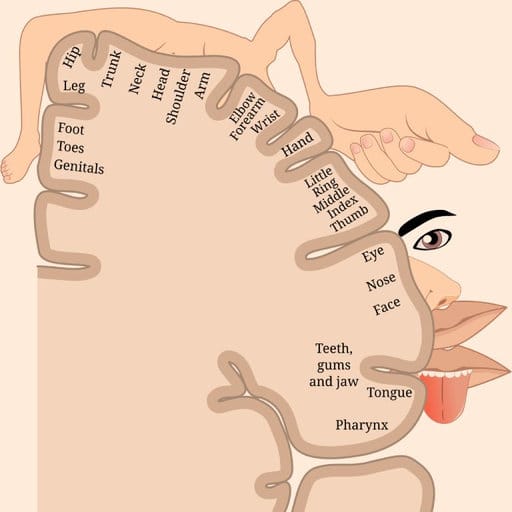
The human brain has a secret map of the entire body. This map is called the sensory homunculus. It is a tiny “person” inside your head that shows which body parts are the most sensitive. Some parts, like the hands and lips, take up a lot of space on this map because they have many nerves. In a yoni massage, we work with this internal map to help the brain feel the body more clearly. When we understand how the brain maps intimacy, we can unlock deeper levels of relaxation and feeling.
The Brain’s Internal Blueprint
The somatosensory cortex is the part of the brain that feels touch. It acts like a blueprint for your physical self. On this neural map, the size of a body part depends on how many nerve endings it has, not its actual physical size. For example, your back is large but has few nerves, so it looks small to the brain. Your fingers are small but have many nerves, so they look huge on the map. This blueprint explains why certain touches feel much more intense than others.

britannica.com
Representing the Pelvic Floor
The pelvic floor is a vital part of the brain’s map, but it is often hidden or unclear. Interestingly, on the sensory homunculus, the genitals are located right next to the area for the feet. This unique placement is a fact of neuroanatomy. Because these areas are so close in the brain, stimulation in the pelvis can sometimes feel like it echoes through the legs. Mapping the pelvic floor correctly in the brain is the first step toward deep somatic awareness and feeling truly present in the body.
The Clitoris on the Neural Map
The clitoris is small on the outside, but it is a giant on the brain’s sensory map. It has thousands of nerve endings that send constant signals to the somatosensory cortex. Because so much brain space is dedicated to this organ, even a very light touch can create a powerful response. This neural representation is why the clitoris is the primary gateway for pleasure. In the brain, it is a bright and active center that helps define the entire experience of intimacy.
Vaginal and Cervical Representation
Science has shown that the brain has separate pathways for different parts of the pelvic anatomy. The clitoris, the vagina, and the cervix each send their own signals to the brain. This means the brain “sees” these areas as distinct but connected zones. When these signals work together, they create a rich and complex feeling of sensitivity. Understanding that these pathways exist helps us move away from the idea of a single “spot” and toward a more integrated view of the body.
wikipedia.org
Neuroplasticity and Sensitivity
The brain is not a fixed object; it can change. This is called neuroplasticity. If a body part is not touched or felt for a long time, its area on the brain’s map can become “blurry” or small. This is often called a sensory blind spot. Through the slow and conscious touch used in yoni massage, we can “wake up” these neurons. This process is more effective when the gut’s neural network signals safety to the brain, allowing it to receive new sensations. By paying close attention to sensation, you are actually building new neural connections and making your internal map more detailed and clear.
The Impact of Stress on the Map
Stress is the enemy of sensitivity. When the body is in a “fight or flight” mode, the brain focuses on survival, not pleasure. High levels of cortisol can make the sensory map feel “numb” or distant. This is why safety is the most important part of any somatic practice. Only when the nervous system feels safe can we begin addressing yoni trigger points to release tension and restore clarity. In a state of relaxation, the brain can finally process the subtle and delicate signals that lead to deep intimacy.
Pacing and Brain Processing
The brain needs time to process touch. If movements are too fast, the brain cannot update its internal map quickly enough. This leads to a “blurred” feeling where you might feel pressure but no real pleasure. Slow pacing is essential because it allows the brain to fully register every sensation. By moving slowly, we trigger the deep pressure receptors to send clearer signals. This patient approach ensures that the brain stays engaged and the sensory map remains sharp and active.
Integration of Body Awareness
True sensitivity is a dialogue between the body and the brain. It is not just about what the skin feels; it is about how the brain understands that feeling. This integration happens when we use our focus to track sensations as they happen. This is the evolution of human consciousness and somatic health in action. When we combine physical touch with mental presence, we move from simple reflex to a deep, lived experience. This awareness helps us bridge the gap between thinking and feeling.
Conclusion
The sensory homunculus shows us that intimacy is a mental and physical process. By learning how the brain maps the body, we can improve our sensitivity and self-awareness. This knowledge helps us respect the integrated functional network that explains how we experience pleasure and safety. When we treat the body with care and the brain with patience, we create a more vibrant and detailed map of our own intimacy. Understanding your brain’s map is a powerful tool for personal growth and pelvic health.