

When a woman begins to breathe deeply during yoni massage, the body starts to speak. Not with words — with sensation. Vibration, numbness, tingling, spasm. Most people are frightened by these reactions and try to stop them.
In reality, they are information. Each one points to something specific — a place where an emotion has been living in the tissue, waiting for a breath deep enough to reach it.
What Are Carpopedal Spasms
Carpopedal spasms are temporary muscle contractions that appear during deep, rhythmic breathing. When breathing deepens, the level of carbon dioxide in the blood shifts.
This change affects how the nervous system communicates with the muscles, producing sensations that range from mild tingling to strong involuntary contraction.
Vibration signals light resistance. Numbness and loss of control signal a medium block. Strong spasm or pain points to something deeper. These reactions are not dangerous and not pathological. They are the body’s way of showing where it holds.
The Hands: Control and Self-Restraint
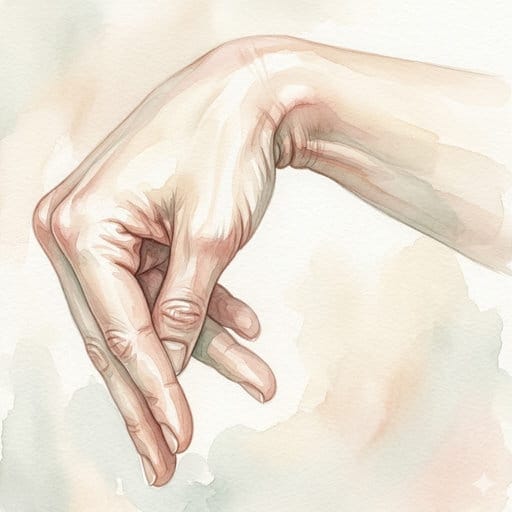
Spasms in the hands are the most common reaction. A person who constantly holds themselves together, manages others, and cannot truly relax will often find that their hands curl and tighten when the breath deepens.
Sometimes the contraction is so strong that the woman cannot straighten her fingers at all. This is the moment when the practitioner’s voice matters most. The right response is simple and calm: “Don’t try to straighten your hands. Just breathe — inhale, exhale.”
The hands hold the story of everything a person has tried to keep under control. Breathing into the contraction, rather than fighting it, is how that story begins to shift.
The Hips and Pelvis: Sexual Prohibition
Spasms in the hip and pelvic region most often reflect sexual prohibitions absorbed in childhood and adolescence. Cultural messages, religious teaching, family silence, or early experiences of shame all leave a physical record in this area.
Research suggests that around sixty percent of women experience difficulty with orgasm — and the pelvis is where much of that difficulty lives as chronic holding. The body literally blocks forward movement.
Breathing into this area during yoni massage is one of the most direct ways to begin releasing what has been held there for years.
The Feet and Calves: Roots and Family
Spasms in the feet and calves speak to the connection with family of origin. Unresolved feelings toward a mother or father, a sense of not belonging, a rejection of the body itself — these tend to settle in the lower legs and feet.
In somatic terms, this is the area of grounding. When a person does not stand firmly on their own ground — when the roots feel unsafe or cut off — the feet are often where that instability shows up.
Working with breath in this area can surface feelings that seem to have nothing to do with the body and everything to do with where a person came from.
The Face: The Mask We Wear
Spasms in the face are a sign of the mask. Most people spend a significant portion of their lives presenting a version of themselves that is not quite real. The face carries this performance constantly.
When breath begins to dissolve the mask, the muscles that hold it in place may contract suddenly. This reaction often surprises women because the face feels so personal, so visible.
The deeper truth is that many people do not know their own face without the performance. Constant activity, noise, and distraction exist partly to avoid the silence in which that real face might appear.
The Lips and Throat: The Silenced Voice
Spasms in the lips and throat reflect the suppression of voice — not just speech but the internal voice, the one that knows what a person actually feels and wants.
When that voice has been consistently silenced, the muscles around the mouth and throat learn to hold. Deep breathing begins to loosen this holding. The woman may feel an urge to make sound, to cry, or simply to open her mouth wider than usual.
These are signs that something is moving through a channel that has been closed for a long time.
Holotropic Breathing and Yoni Massage
In holotropic breathwork, these reactions appear in a much stronger form. Breath is faster, deeper, and sustained for longer, giving the body less time to manage what arises.
In yoni massage, the same reactions occur with greater gentleness — the breath is slower, the context is more intimate, and the level of safety is usually higher.
Both practices access the same material through the same mechanism: breath that goes deep enough to reach what the mind has kept at a distance. The difference is degree, not kind.
How to Respond as a Practitioner
The most important thing a practitioner can do during a spasm is stay calm. Rather than intervening or rushing to relieve the discomfort, the practitioner simply stays present and reminds the woman to keep breathing.
The tone of voice matters as much as the words.
A calm, steady voice that says “just breathe — inhale, exhale” does more than any technique — and a practitioner who understands these reactions as meaningful rather than alarming becomes the anchor that allows the woman to stay with what is arising rather than pulling away from it.
Breathing Through and Integration
If the woman hears the practitioner and continues to breathe, the emotion moves through completely. It does not leave a trace in that place. The spasm releases, the tissue softens, and that particular pattern does not return. This is full resolution.
If the woman stops breathing before the release is complete, the breath still does its work — it removes a layer. The block does not return immediately, but it will come back in a later session, asking for the same attention. Regular practice produces results that a single session cannot.
After a release, the body needs time — silence, warmth, and stillness allow the nervous system to absorb what has shifted.
To explore how breath and bodywork come together in practice, visit our complete yoni massage program.